

Mechanical Testing
FAQs


What does CellScale specialize in?
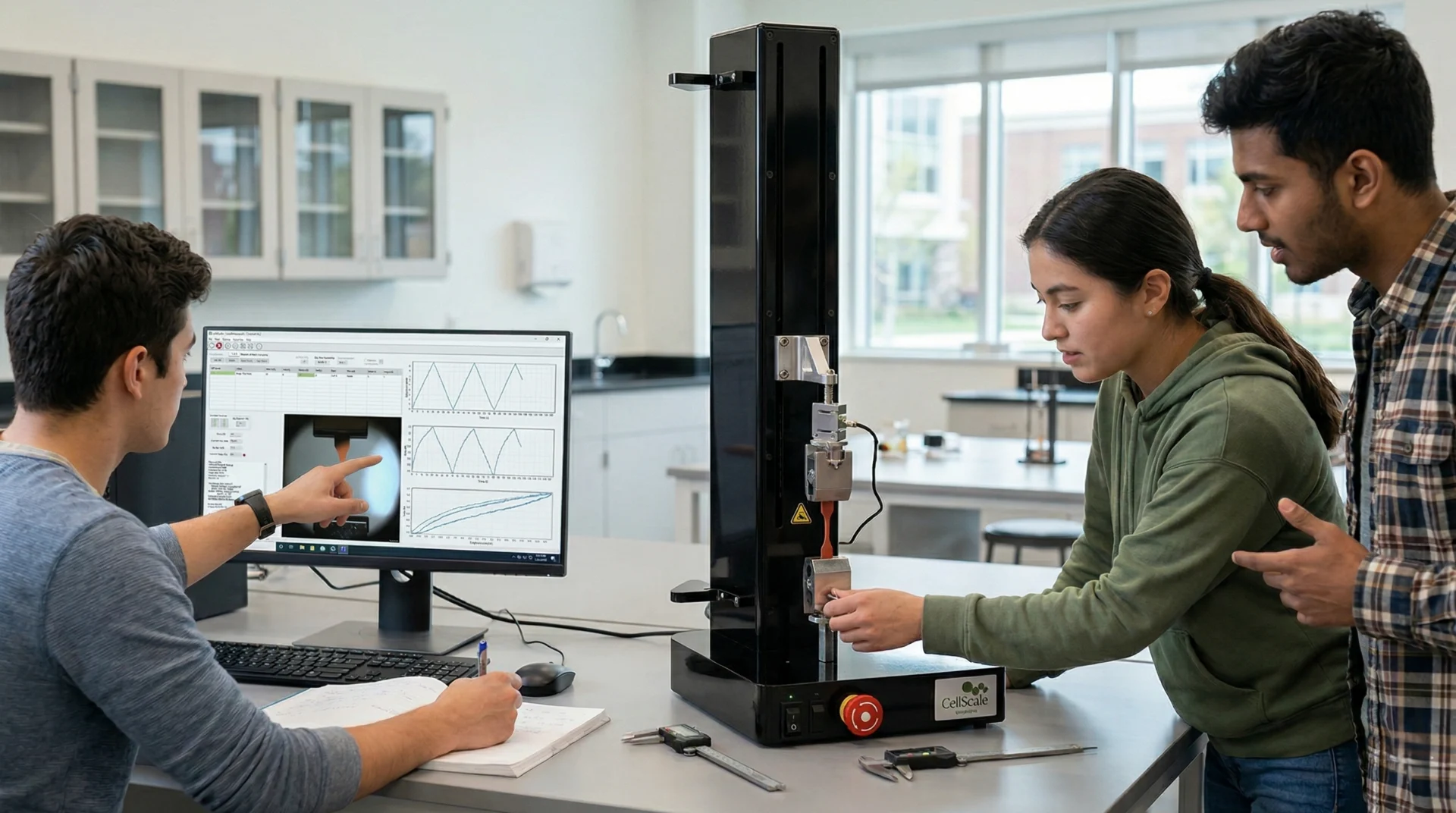
CellScale produces benchtop mechanical testing equipment for use with biomaterials, soft tissues, and engineered materials. These systems are used to collect mechanical testing data in research and development environments.
Where is CellScale located?
The CellScale team operates out of Waterloo, Ontario, Canada. Product development and technical support are based at this location. Developed in-house by our engineers, our instruments are shipped internationally.
Do CellScale instruments require special lab infrastructure?
All of our mechanical testing systems and bioreactors are designed for benchtop testing. They require only standard lab power outlets and minimal bench space. Depending on your application, you may need compressed air, dedicated computer connections, or incubator use, which could add additional components to the system(s).
Can I request a product demo before purchase?
Yes. Virtual demos are available for all mechanical testers and bioreactors. Depending on needs, location, and feasibility, in-person demonstrations may be arranged.
Who uses CellScale testing systems?
CellScale mechanical testers and bioreactors are used in university laboratories, research hospitals, and industrial research settings. Researchers use our instruments in mechanobiology, tissue engineering, bioelectronics, biomaterials testing, and related areas. You will find CellScale instruments cited in peer-reviewed literature going back to 2008.
How long has CellScale been in business?
CellScale has been developing mechanical testing systems since 2005. It began with the development of a biaxial testing system to study the relationship between glaucoma and scleral stiffness at the University of Waterloo. That system eventually became the BioTester, the first product in the CellScale lineup.
Does CellScale ship internationally?
Yes, CellScale ships instruments and accessories to laboratories outside of Canada, including through various distributor partnerships. In many cases, international shipments are handled through established logistics partners.
Can CellScale systems be customized?
Yes. Many CellScale systems can be adapted with custom grips, fixtures, accessories, or software modules to support specialized mechanical testing applications. For a great example, read our case study where the University of Michigan 3D-printed testing fixtures to use with the UniVert S2 to develop an ACL injury model in mice.
Does CellScale provide training on its systems?
Yes, up to 10 hours of virtual training is included with our CellScale systems. These are done remotely, and typically cover system setup, software operation, and best practices.
Does CellScale provide remote technical support?
Remote technical support is available through live video calls, phone calls, and email. Screen sharing or log files may be necessary for troubleshooting.
How often should I calibrate my CellScale testing system?
Many laboratories calibrate annually or after system relocation, repair, or significant changes in usage. Calibration frequency could also depend on your institutional or regulatory requirements. We have product-specific details in our instrument user manuals on the Downloads & Manuals page.
Do I need to recalibrate my system after moving it to another lab?
Yes. Relocation can affect alignment and load cell performance, so recalibration is recommended after moving mechanical testing instruments.
What software is included with CellScale systems?
All CellScale systems include proprietary instrument control and data acquisition software that enables real-time data visualization, automated test protocols, and data export for analysis. Our mechanical testers come with LabJoy software, our proprietary data acquisition and control software, which enables real-time data visualization, automated test protocols, and export of results. CellScale mechanical testing systems also come with Data Analysis software, which you can learn more about here.
What operating systems are supported?
Current software versions are supported on Windows 11. Legacy software continues to support Windows 10 and assistance for legacy software is available. Other operating systems are not supported.
Can CellScale software export data to third-party analysis tools?
Test data can be exported in standard file formats, including CSV, for use with external analysis software. Our Data Analysis page has more information.
Does the software require an internet connection?
No. CellScale software runs locally. An internet connection is only required for software updates or remote technical support.
What kinds of materials can CellScale systems test?
CellScale systems are optimized for testing soft materials, biomaterials, tissues, hydrogels, scaffolds, and small engineered devices. Some configurations can also support harder polymers and composite materials.
Can CellScale systems apply compression as well as tension?
Yes. Many CellScale testing systems support both tensile and compressive loading modes, such as the UniVert and MicroTester.
Do CellScale systems support torsion or shear testing?
Yes. Specialized fixtures and accessories are available to enable shear and torsion testing on the UniVert. Shear testing is also possible on the MicroTester, at the micro-scale.
What force ranges are available with CellScale testing systems?
Specific force ranges depend on system configuration (from 40 uN with the Eclipse Sensor to 1000 N with the UniVert 1kN). CellScale systems support a wide range of forces, from extremely low-force measurements for delicate biomaterials on the MicroTester or with the Eclipse, to higher loads suitable for more robust samples on the UniVert or BioTester.
Do CellScale systems support cyclic or fatigue testing?
Yes. Many systems (like the UniVert, MechanoCulture series, BioTester, and MicroTester) support cyclic, fatigue, and time-dependent testing protocols with programmable loading profiles.
How do I choose between the UniVert, BioTester, MicroTester, or MechanoCulture systems?
The choice depends on your sample size, material type, force range, and type of mechanical test. Each have specific abilities – for example the BioTester has biaxial capabilities; the UniVert can perform tension, compression, peel, torsion, pressure, and other testing methods; the MicroTester is a micro-scale mechanical tester, mainly for compression; and the MechanoCulture series of bioreactors are stimulation-focused with multi-well capabilities for tissue and cell culture studies. Contact our team for recommendations.
Is the MicroSquisher still in production?
Sort of 😊. The MicroSquisher has been superseded by the MicroTester, which provides expanded capabilities and improved performance while maintaining the core functionality of the original MicroSquisher. Manuals and documentation for the MicroSquisher are still available on the Manuals and Downloads page.
Is the UStretch still in production?
The UStretch is no longer in production and has been replaced by the UniVert system, which has all the capabilities of the UStretch plus a lot more. Legacy UStretch documentation remains available through Manuals and Downloads.
Are older MechanoCulture bioreactor systems still supported?
Earlier MechanoCulture bioreactors such as the MCFX and MCB1 are no longer in production. Documentation is available for reference through Manuals and Downloads. Current MechanoCulture systems have similar capabilities (and more) to support modern research and educational applications. See Bioreactors for more details on the current MechanoCulture lineup.
Still Have Questions?
If you cannot find an answer here in our mechanical testing FAQs, additional resources are available.