Cranial dura mater biomechanics is an important area of research because the dura mater plays a critical mechanical role in protecting the brain within the skull. This dense collagenous membrane is not mechanically uniform. Its stiffness and tensile response vary with loading direction, making it a strongly anisotropic tissue that must be studied with methods capable of capturing direction-dependent behaviour.
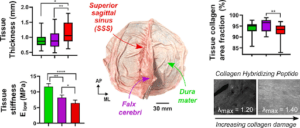
Using biaxial tensile testing on the CellScale BioTester, researchers can quantify directional stiffness, elastic modulus, and deformation behaviour in human cranial dura mater. This type of testing helps explain how the dura mater contributes to brain protection, distributes mechanical loads, and responds to forces associated with trauma, surgery, and normal physiologic loading.
Why Cranial Dura Mater Biomechanics Matters
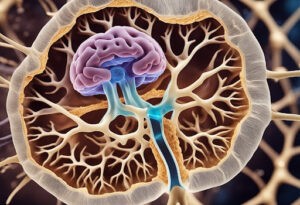
The dura mater is the outermost meningeal layer surrounding the brain and spinal cord. In the cranial environment, it forms a mechanically important interface between the skull and delicate neural tissue. Because it helps constrain and support the brain under load, understanding cranial dura mater biomechanics is relevant to both basic biomechanics research and clinical applications.
Research into cranial dura mater biomechanics helps investigators better understand:
-
how the tissue resists deformation under tensile loading
-
how anisotropy influences load distribution
-
how the dura mater contributes to brain protection
-
how age or pathology may alter tissue mechanics
-
how tissue properties can inform modeling, surgical planning, and injury analysis
Dura Mater Structure and Mechanical Function
The dura mater is a dense fibrous membrane composed primarily of collagen. Its organized fibrous architecture gives it strength, but that strength is not identical in every direction. This is why dura mater mechanical properties must be interpreted in relation to tissue structure and loading orientation.
Within the skull, the dura mater helps stabilize the mechanical relationship between the brain and the cranial boundary. It provides resistance to tensile loading, helps distribute forces, and contributes to the protective biomechanics of the central nervous system. These functions make cranial dura mater biomechanics important for understanding both normal protection and injury mechanisms.
Biaxial Testing of Dura Mater
A key strength of this research area is the use of biaxial testing of dura mater rather than relying only on simpler uniaxial methods. Using the BioTester, researchers can apply controlled loading in two directions to better represent the mechanical environment experienced by the tissue.
This is especially important because the dura mater is anisotropic. If a tissue behaves differently depending on loading direction, then testing in only one axis may miss important features of its response. Biaxial tensile testing allows researchers to capture direction-dependent stiffness and better characterize the mechanical behaviour of the tissue.
In studies of cranial dura mater biomechanics, biaxial testing is useful for measuring:
-
directional stiffness
-
elastic modulus
-
strain response
-
anisotropic mechanical behaviour
-
tissue deformation under multi-axis loading
Why Biaxial Mechanical Testing Is Critical for Dura Mater
This tissue is not mechanically simple. The collagen structure of the dura mater creates directional behaviour that is highly relevant to its protective role. That is why biaxial testing of dura mater is so valuable.
A biaxial approach matters for several reasons:
It captures anisotropy more effectively
Because the dura mater has direction-dependent properties, loading it in two axes provides a more realistic picture of mechanical response than single-axis testing alone.
It improves tissue characterization
When researchers want to understand dura mater mechanical properties, biaxial testing helps separate how the tissue responds along different orientations.
It supports brain biomechanics research
In brain biomechanics, tissues rarely experience purely one-dimensional loading. Biaxial mechanical testing helps researchers generate data that are more useful for understanding physiologic and traumatic conditions.
It informs computational modeling
Material property data from cranial dura mater biomechanics studies can improve finite element models of the head and support more realistic simulation of injury or surgical scenarios.
Anisotropy in Cranial Dura Mater Biomechanics
One of the most important findings in cranial dura mater biomechanics is that the tissue is anisotropic. In practical terms, this means the mechanical response depends on the direction in which the tissue is loaded.
This anisotropy affects how the dura mater stretches, resists deformation, and transfers load. It also means that reported tensile properties such as stiffness and elastic modulus must be interpreted carefully, especially when comparing studies that may use different sample orientations or loading protocols.
For tissues like the cranial dura mater, anisotropy is not a minor detail. It is central to understanding how the tissue functions mechanically and how it contributes to protecting the brain.
Dura Mater Mechanical Properties and Brain Protection
The role of the dura mater in brain protection is closely tied to its mechanical behaviour. The tissue must be strong enough to help resist deformation, yet compliant enough to participate in the complex mechanical relationship between the skull and brain.
Studies of dura mater mechanical properties help explain how this membrane:
-
absorbs and redistributes force
-
resists tensile loading
-
contributes to cranial stability
-
helps reduce damage to neural tissues during mechanical events
This is why cranial dura mater biomechanics has relevance beyond anatomy alone. It directly supports research into traumatic brain injury, head impact modeling, surgical planning, and the design of protective strategies.
Aging and Variation in Dura Mater Mechanical Properties
Another important question in cranial dura mater biomechanics is how tissue properties change with age. As the dura mater ages, its structure and mechanical response may change, potentially affecting stiffness, elasticity, and tolerance to strain.
These changes matter because age-related variation can influence injury susceptibility, interpretation of biomechanical data, and the accuracy of head models that rely on tissue material properties. Continued research into dura mater mechanical properties is important for understanding this variation and its clinical significance.
Clinical and Research Relevance
The significance of cranial dura mater biomechanics extends across both clinical and research settings.
Surgical relevance
A better understanding of the mechanical behaviour of the dura mater can support surgical planning and improve awareness of how the tissue responds during cranial procedures.
Head injury modeling
In brain biomechanics, accurate tissue property data are essential for finite element analysis and other modeling approaches used to study trauma and protective mechanisms.
Training and simulation
Biomechanical characterization of the dura mater can also support the development of more realistic surgical phantoms and research models.
Neuroprotective research
By improving understanding of dura mater mechanical properties, researchers can strengthen broader efforts to study how cranial tissues protect the central nervous system under load.
Why Mechanical Testing Matters
This research area shows why mechanical testing is essential for understanding soft tissues with structural anisotropy. The dura mater cannot be fully characterized by anatomy alone. Its function depends on measurable mechanical behaviour.
Using the BioTester for biaxial tensile testing gives researchers a way to quantify how this tissue behaves under controlled multi-axis loading. That makes it possible to study cranial dura mater biomechanics in a way that is rigorous, repeatable, and relevant to real biomechanical questions.
For CellScale readers, this is also an important example of how the right test method helps reveal tissue behaviour that would otherwise remain hidden. In anisotropic tissues such as the dura mater, test selection directly affects the quality and usefulness of the data.
Conclusion
Cranial dura mater biomechanics is a valuable research topic because it connects tissue structure, anisotropy, and mechanical function to the protection of the brain. By using biaxial tensile testing on the CellScale BioTester, researchers can better quantify directional stiffness, elastic modulus, and mechanical response in this important cranial tissue.
This work supports a deeper understanding of dura mater mechanical properties, improves the biomechanical study of brain protection, and provides useful data for clinical research, computational modeling, and neuroprotective applications.
For those interested in the secrets of Spinal Health discovered through advanced biomechanical research, read about it HERE.