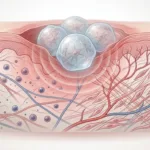
Axial torsion of annulus fibrosus is closely tied to the mechanics of intervertebral disc injury. The annulus fibrosus is the layered outer structure of the intervertebral disc, surrounding the nucleus pulposus and helping contain internal disc pressure under daily loading. When those annular layers fail, the risk of disc herniation increases. Torsional loading, especially when combined with other spinal motions, has long been associated with herniation risk, but the specific tissue-level damage mechanisms are not always clear.
That is what makes this study from Maxine Harvey-Burgess and Diane E. Gregory especially useful. The authors examined how axial torsion of annulus fibrosus affected both the interlamellar matrix, which helps hold annular layers together, and the intralamellar matrix, which provides strength within the layers themselves. CellScale contributed directly to this work through the use of both the BioTester and the UniVert, which supported biaxial, peel, and tensile testing of annulus fibrosus samples.
For broader context on why these methods matter, see our guide to mechanical testing of biomaterials.
Why axial torsion matters in disc herniation
Intervertebral disc herniation is commonly discussed in terms of compression and degeneration, but rotation also matters. The paper’s background makes this clear: axial torsion of annulus fibrosus, particularly when combined with repetitive flexion, has been associated with increased herniation risk. The challenge is understanding exactly what torsion damages first. Does it weaken adhesion between annular layers, or does it disrupt the layers themselves?
That distinction is important for intervertebral disc herniation biomechanics. If torsion mainly damages the intralamellar structure, then repair or prevention strategies may need to focus more on lamellar integrity than on interlamellar adhesion alone. This paper helps move that question forward.
What the researchers tested
The study used bovine caudal intervertebral discs as an in vitro model. The discs were exposed to either 0 degrees or 12 degrees of static axial torsion, along with either 0 N or 1000 N of compression for 2 hours, to generate controlled micro-damage. After loading, the researchers dissected one multilayer annulus fibrosus sample and two single-layer samples from each disc for further testing of the interlamellar and intralamellar matrices.
This setup gave the study a strong mechanics framework. Rather than only observing gross tissue damage, the authors separated the testing into different annular structural levels so they could ask whether axial torsion of annulus fibrosus changed peel behaviour between layers or tensile behaviour within layers.
How CellScale instruments were used
CellScale’s involvement in the study is one of the clearest strengths for the blog. The BioTester and UniVert were both used in the experimental workflow. The BioTester supported biaxial testing, while the UniVert supported uniaxial tension testing, and the study also included peel-style testing of layer adhesion.
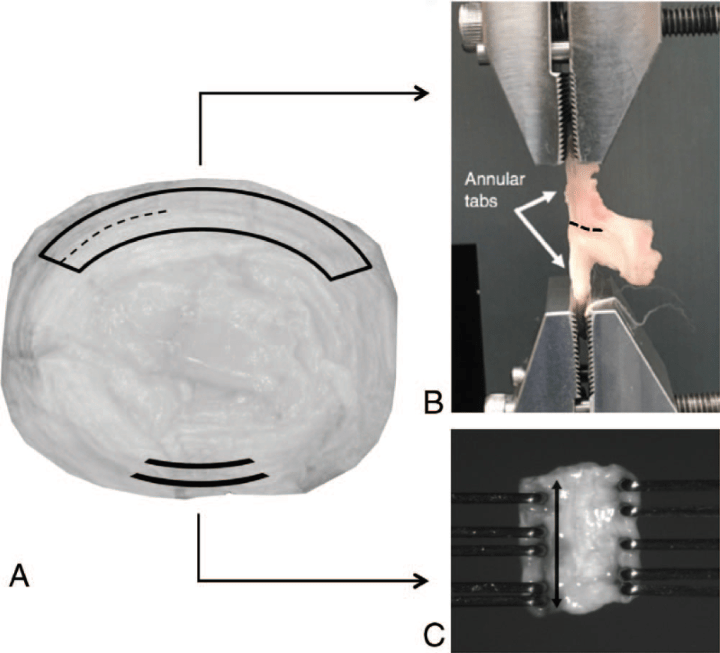
That matters because annulus fibrosus mechanical testing is not well captured by a single loading mode. The annulus is a layered, anisotropic structure, so multiple tests are needed to separate behaviour within lamellae from behaviour between them. This paper is a good example of how different CellScale systems can support a more complete mechanical picture of disc tissue.
For readers interested in a broader introduction to mechanics terminology, our post on mechanical testing of biomaterials for non-engineers may also be helpful.
Biaxial, peel, and tensile testing each answered a different question
Biaxial testing of annulus fibrosus helps characterize tissue response under multi-directional loading. Peel testing of annulus fibrosus helps probe adhesion between annular layers. Tensile testing of annulus fibrosus helps determine how much load individual layers can carry before failure. Together, these methods create a more specific view of how torsion changes tissue behaviour.
The paper is not only about spinal rotation in general. It is about how different mechanical tests were used to isolate damage mechanisms within annulus fibrosus structure.
Key structural finding: torsion disrupted layers more than adhesion
The study found that axial torsion affected the mechanical properties of the intralamellar matrix but did not produce the same effect on the interlamellar matrix. In practical terms, axial torsion of annulus fibrosus reduced tensile strength within the annular layers, while peel strength between layers was not significantly altered.
That is a meaningful result for annular layer disruption and disc injury mechanics. It suggests that torsion-related herniation risk may be driven less by a simple loss of adhesion between layers and more by structural disruption of the layers themselves.
What this means for intervertebral disc mechanics
From a broader biomechanics perspective, the study helps refine how we think about intervertebral disc mechanics under rotational loading. Not all tissue failure pathways are the same. Compression, flexion, and torsion may each damage the annulus in different ways, and this study suggests that torsion can create a specific vulnerability at the lamellar level.
That matters for both basic science and translational work. Researchers interested in annulus repair, disc replacement, or degeneration models need to know whether a loading mode is more likely to separate layers or weaken them internally. This paper points more strongly toward the second mechanism in the context studied here.
Final thoughts
This paper is a useful example of how axial torsion of annulus fibrosus can be studied with a targeted combination of loading and mechanical testing methods. By using bovine intervertebral discs, controlled torsional loading, and follow-up biaxial, peel, and tensile testing, the authors were able to distinguish between interlamellar adhesion and intralamellar tissue strength. Their findings suggest that torsion increases herniation risk primarily through disruption within annular layers rather than by substantially weakening adhesion between them.
For CellScale, the study also highlights how the BioTester and UniVert can be used together in soft tissue and disc mechanics research. That combination helped create a more complete mechanical picture of annulus fibrosus behaviour under torsional damage conditions.
Read the full journal article here: The Effect of Axial Torsion on the Mechanical Properties of the Annulus Fibrosus
Read about Dr. Gregory’s research here: Wilfrid Laurier University faculty profile
For related reading, you may also like: