Designing a durable bioprosthetic valve leaflet is not really about determining one impressive tensile number and moving on. In practice, the design process is messier than that. A leaflet opens and closes millions of times, sits in a controlled environment, and carries load in more than one direction at once. If the material slowly deforms, relaxes stress, or responds differently along different fibre directions, that starts to matter pretty quickly.
That is what makes this Bioengineering study on porcine pericardium biaxial testing worth a closer look. The authors were interested in the viscoelastic behaviour of porcine pericardium under biaxial creep and stress relaxation, with the larger goal of improving inputs for aortic valve bioprosthesis design and simulation. Rather than treating pericardium as a simple sheet with one convenient property, they tested how it behaved over time under sustained biaxial loading.
The study also used the CellScale BioTester in a way that is easy to explain and easy to connect to real valve development. Tissue samples were mounted biaxially, tested in PBS, and brought to physiological temperature before creep and stress relaxation measurements were collected. From there, the authors fitted viscoelastic model parameters that could be carried into later finite element and fluid-structure interaction work.
Why does porcine pericardium biaxial testing matter for heart valve design?
The short version is that valve leaflets do not experience simple one-direction loading in use. They flex, stretch, recover, and redistribute stresses under repeated physiological conditions. So if the material is being considered for aortic valve bioprosthesis design, its time-dependent and direction-dependent behaviour starts to matter, not just its peak strength.
That is the logic behind porcine pericardium biaxial testing in this paper. The authors point out that many studies on leaflet materials rely on uniaxial or biaxial mechanical tests, but that time-dependent behaviour is still not always described clearly enough for long-term design work. Their focus here was not just whether porcine pericardium is strong enough in a broad sense, but how it creeps and relaxes under biaxial tension, and whether those responses can be translated into constitutive model parameters for later simulation.
For readers looking for broader context on leaflet tissue behaviour before getting into time-dependent testing, our post on mechanical properties of heart valve leaflets is a useful starting point.
How was porcine pericardium tested under biaxial creep and stress relaxation?
The experimental setup is one of the cleaner parts of the paper. Porcine pericardium samples were excised from hearts collected soon after slaughter, cut into small square specimens, and mounted for biaxial testing. The authors used a BioTester 5000 with BioRakes to grip the tissue in the circumferential and radial directions. Testing was done in PBS at 37°C to better mimic physiological conditions.
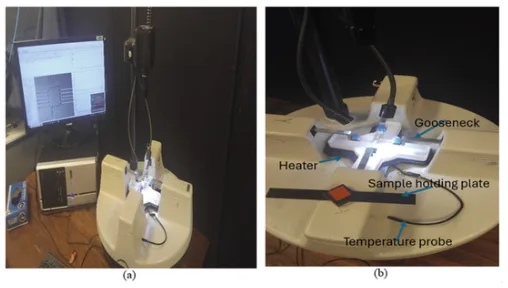
Experimental setup used for porcine pericardium biaxial testing. Panel (a) shows the BioTester 5000 system with our LabJoy Test Control Software. Panel (b) shows the goosenecks, sample holding plate, heater, and temperature probe used during hydrated, temperature-controlled testing. Adapted from Matjeka E, et al. Viscoelastic Properties of Porcine Pericardium Under Biaxial Tensile Creep and Stress Relaxation: Application for Novel Aortic Valve Bioprosthesis Design. Bioengineering. 2026.
They also preconditioned the samples before the main measurements. That matters, because with soft tissues you usually want to settle the mechanical response before asking longer time-dependent questions.
For creep, the tissue was subjected to equibiaxial tensile loading and held under load for 30 minutes. For stress relaxation, the setup was similar, but the tissue was held at a constant 10% strain instead. Those two tests complement each other. One asks how strain evolves under sustained load. The other asks how stress decays under sustained deformation.
What did the biaxial creep results show in porcine pericardium?
The creep data are interesting partly because they are not dramatic. Under sustained biaxial load, both directions showed relatively modest strain increases over time, which is probably the main reason the authors frame the tissue as promising for valve applications.
At the same time, the material was not behaving isotropically. The radial direction showed higher strain than the circumferential direction, so the tissue still retained directional character under biaxial loading. That is an important detail for heart valve leaflet mechanics. A leaflet material can look stable overall and still distribute deformation differently depending on fibre orientation and loading direction.
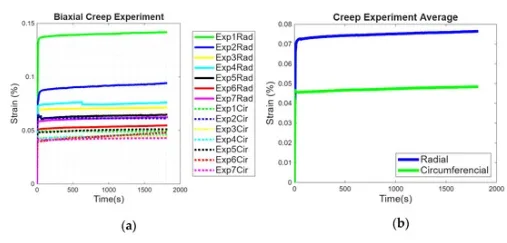
Biaxial creep results from porcine pericardium biaxial testing. Panel (a) shows the individual creep experiments in the circumferential and radial directions. Panel (b) shows the averaged creep response, where the radial direction remains more compliant over time. Adapted from Matjeka E, et al. Viscoelastic Properties of Porcine Pericardium Under Biaxial Tensile Creep and Stress Relaxation: Application for Novel Aortic Valve Bioprosthesis Design. Bioengineering. 2026.
The paper reports that after 30 minutes of creep, deformation was higher in the radial direction than in the circumferential direction. Statistically, the selected timepoint comparisons did not show significant differences between directions, but the average curves still show the radial response sitting above the circumferential one. In practice, that seems like the more useful reading of the figure. The tissue is anisotropic, though its creep response remains relatively controlled over the test window.
That balance is probably what makes the result useful. The study does not suggest porcine pericardium is mechanically simple. It suggests that its time-dependent response is measurable, directional, and stable enough to be modelled.
Why use biaxial testing instead of uniaxial testing for pericardial tissue?
A uniaxial pull test can tell you something useful about soft tissue, but a valve leaflet does not operate as a strip pulled in one direction. It sees multiaxial loading, and the tissue architecture is not directionless. In this study, porcine pericardium biaxial testing allowed the authors to compare circumferential and radial behaviour under conditions that are a bit closer to how leaflet materials are actually loaded in vivo.
That becomes especially relevant when you start thinking about simulation. If the end goal is aortic valve bioprosthesis design, or later finite element analysis of leaflet mechanics, a biaxial dataset is usually more informative than a single-axis tensile result.
What did the stress relaxation results show in porcine pericardium?
The stress relaxation results complement the creep data nicely. Here, the circumferential direction initially carried more stress than the radial direction, and both directions relaxed over time while maintaining the same overall pattern.
Again, this is not a flashy result, but it is a useful one. The circumferential direction appears stiffer in terms of the stress it carries at the imposed strain, while the radial direction is lower. Over the 30-minute period, both directions relaxed, but not to the point where the tissue looked mechanically unstable. That is part of the design relevance. A leaflet material that relaxes too much or too unpredictably could affect sealing, opening behaviour, or the local stress state used in computational predictions.
The authors discuss this in the context of how a valve should still open sufficiently and seal effectively while tolerating repeated loading. That part is somewhat interpretive, but the underlying point makes sense: time-dependent response is not a side issue in leaflet design. It is part of the design problem.
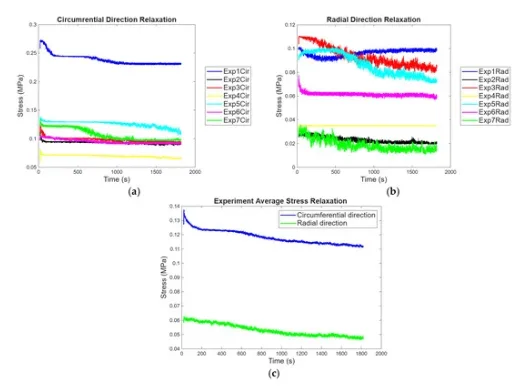
Stress relaxation results from porcine pericardium biaxial testing. Panel (a) shows the circumferential direction across seven experiments, panel (b) shows the radial direction, and panel (c) shows the averaged stress relaxation response for both directions. Adapted from Matjeka E, et al. Viscoelastic Properties of Porcine Pericardium Under Biaxial Tensile Creep and Stress Relaxation: Application for Novel Aortic Valve Bioprosthesis Design. Bioengineering. 2026.
For another valve-focused example, our post on 3D printed aortic valve phantom mechanics shows how mechanical testing also supports evaluation of valve-like structures beyond native tissue samples.
How can these viscoelastic data support aortic valve bioprosthesis design?
This is where the paper becomes more than a measurement study. The authors did not stop at reporting creep and stress relaxation curves. They also fitted viscoelastic constitutive models to the data using Prony-series formulations, with the aim of generating material parameters for later finite element analysis and fluid-structure interaction modelling.
For creep, they used a generalized Kelvin-Voigt approach. For stress relaxation, they used a generalized Maxwell model. The point was not just to fit a curve for the sake of fitting a curve. It was to produce parameters that could later be used in simulations of valve performance and durability.
That matters because design teams do not only need to know that porcine pericardium is viscoelastic. They need usable inputs for models that estimate leaflet deformation, stress distribution, and longer-term mechanical performance. If you are building or refining an aortic valve bioprosthesis, that is where this kind of porcine pericardium biaxial testing starts to become practically useful.
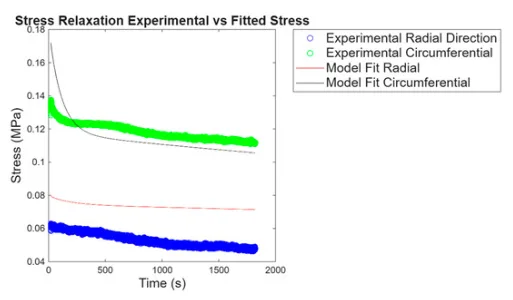
Average experimental and fitted stress relaxation data used to translate porcine pericardium biaxial testing results into constitutive model parameters. The figure compares averaged experimental responses with the fitted Maxwell model in both loading directions. Adapted from Matjeka E, et al. Viscoelastic Properties of Porcine Pericardium Under Biaxial Tensile Creep and Stress Relaxation: Application for Novel Aortic Valve Bioprosthesis Design. Bioengineering. 2026.
If you are interested in how material data carry forward into computational workflows, our research highlight on mitral valve biomechanics and FSI simulation looks more closely at the modelling side of valve mechanics.
How was the BioTester used in the study?
The BioTester was used here as a biaxial soft tissue testing platform rather than as a simple tensile instrument. That distinction is worth making. The tissue was mounted in two directions, tested while hydrated in PBS, and brought to physiological temperature before creep and stress relaxation protocols were applied.
In other words, the instrument was part of how the authors tried to make the test conditions more meaningful for valve leaflet materials. It let them look at circumferential and radial responses together, while also keeping the tissue in a hydrated, temperature-controlled environment during time-dependent measurements.
That is a practical use case for the BioTester in Heart Valve Tissue Engineering & Mechanics work. It is also a good example of how Biaxial Testing and Viscoelastic & Time-Dependent Testing often need to be combined rather than treated as separate boxes.
About the BioTester
The CellScale BioTester is used for mechanical characterization of soft tissues, biomaterials, and engineered constructs under physiologically relevant conditions. In this study, it was used for porcine pericardium biaxial testing with hydrated, temperature-controlled loading, allowing the authors to measure both creep and stress relaxation in circumferential and radial directions.
That kind of workflow is especially relevant when the material is being considered for leaflet applications, where directional mechanics and time-dependent behaviour can influence how a design performs in later modelling and, eventually, in use.
For researchers working on valve tissues, pericardial biomaterials, or computational design pipelines, this study is a useful reminder that a single strength value usually is not enough. The more interesting question is how the material behaves over time, under biaxial load, in conditions that begin to resemble the environment it is meant to survive in.