Mitral valve biomechanics sits at the intersection of soft tissue mechanics, cardiac flow, and computational modelling. The mitral valve does not function in a static setting. It opens and closes within a moving fluid environment, while its leaflets and chordae deform under highly dynamic loading. That is why fluid-structure interaction, or FSI, has become such an important framework for understanding normal valve function and for improving predictive heart valve models.
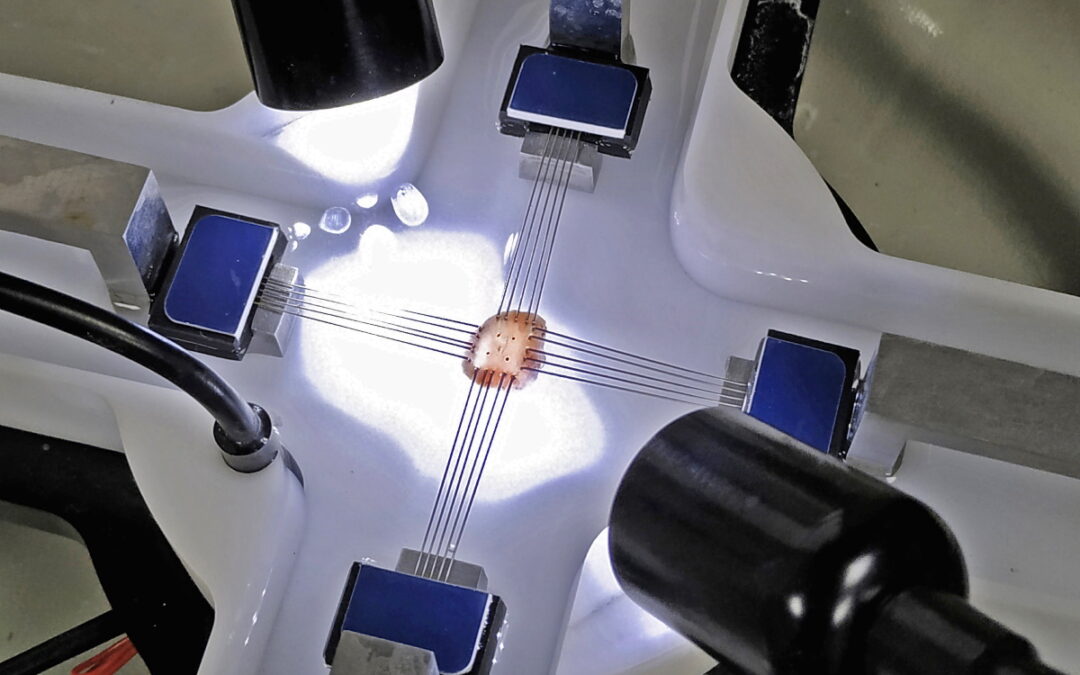
In this Scientific Reports study, researchers from the University of Glasgow, Northwestern Polytechnical University, Xi-an University of Technology, and Chongqing University compared several constitutive laws for mitral valve leaflets and chordae tendineae within an FSI model of the mitral valve. CellScale contributed to the experimental side of that workflow through the use of the BioTester, which was used for planar biaxial testing of mitral valve tissue. That mechanical testing helped inform how leaflet material behaviour was represented in the computational model.
This makes the paper especially useful for readers interested in fluid-structure interaction mitral valve modelling and experimental validation of FSI models, because it directly connects tissue testing to simulation outcome.
Why mitral valve biomechanics matters in simulation
The mitral valve has a complex layered structure and experiences anisotropic, nonlinear loading during the cardiac cycle. That means simple linear material assumptions can miss important aspects of real valve behaviour. In practice, the choice of constitutive law can affect how a simulated valve opens, closes, and resists regurgitation under physiological pressure loading.
That is the key question behind this paper. The authors wanted to know how different material laws for the leaflets and chordae tendineae would change predicted valve dynamics in an FSI framework. Instead of treating constitutive law selection as a purely mathematical choice, they linked it back to experimental mechanics. That is what makes this study such a strong example of mitral valve biomechanics in action.
For another related valve mechanics post, see 3D printed aortic valve phantom mechanics.
What the researchers compared
The study evaluated three constitutive laws for the mitral valve leaflets and two constitutive laws for the chordae tendineae. These laws were then used within a hybrid immersed boundary and finite element FSI framework to simulate mitral valve motion under physiological loading conditions. The authors compared outputs such as transvalvular flow rate, peak jet velocity, closure regurgitation, and valve orifice area.

This is an important design choice. Rather than only asking which constitutive law fit static material data well, the paper asked how those laws affected dynamic behaviour in a functioning valve model. That is a much more relevant question for computational mitral valve modelling, because the purpose of these models is to predict how valves behave under real cardiac loading.
How the CellScale BioTester was used
CellScale’s role in the paper came through the experimental characterization of mitral valve tissue using the BioTester. Fresh porcine mitral valve samples were tested in planar biaxial tension under hydrated, temperature-controlled conditions, and the resulting stress-strain data were used to evaluate how well different leaflet constitutive laws captured tissue behaviour.
That point matters because the constitutive laws were not chosen in isolation. They were assessed against real mechanical data. In other words, the biaxial mechanical testing of heart valves helped determine which material descriptions were reasonable candidates for the FSI simulations.
This also strengthens the structure-function story of the paper. The experimental data did not just sit beside the simulation work. It informed the constitutive law selection process that shaped the predicted mitral valve dynamics.
For another related example, see biaxial heart tissue testing at the University of Denver.
Why biaxial testing matters for mitral leaflet mechanics
Mitral valve leaflets are anisotropic soft tissues, which means their mechanical response depends on direction. That is why biaxial mechanical testing of heart valves is especially valuable. It captures directional behaviour in a way that uniaxial testing cannot, making it more relevant for tissues that operate in a multi-axial loading environment.
In this study, the leaflet constitutive laws were evaluated against biaxial stretch-stress behaviour along both fiber and cross-fiber directions. That makes the work a good example of how mitral leaflet mechanical properties can be translated into computational inputs that are more physiologically grounded.
This is also where the BioTester’s contribution becomes especially meaningful. The BioTester data helped anchor the model to measured tissue response rather than relying only on idealized assumptions.
What changed when the leaflet constitutive law changed
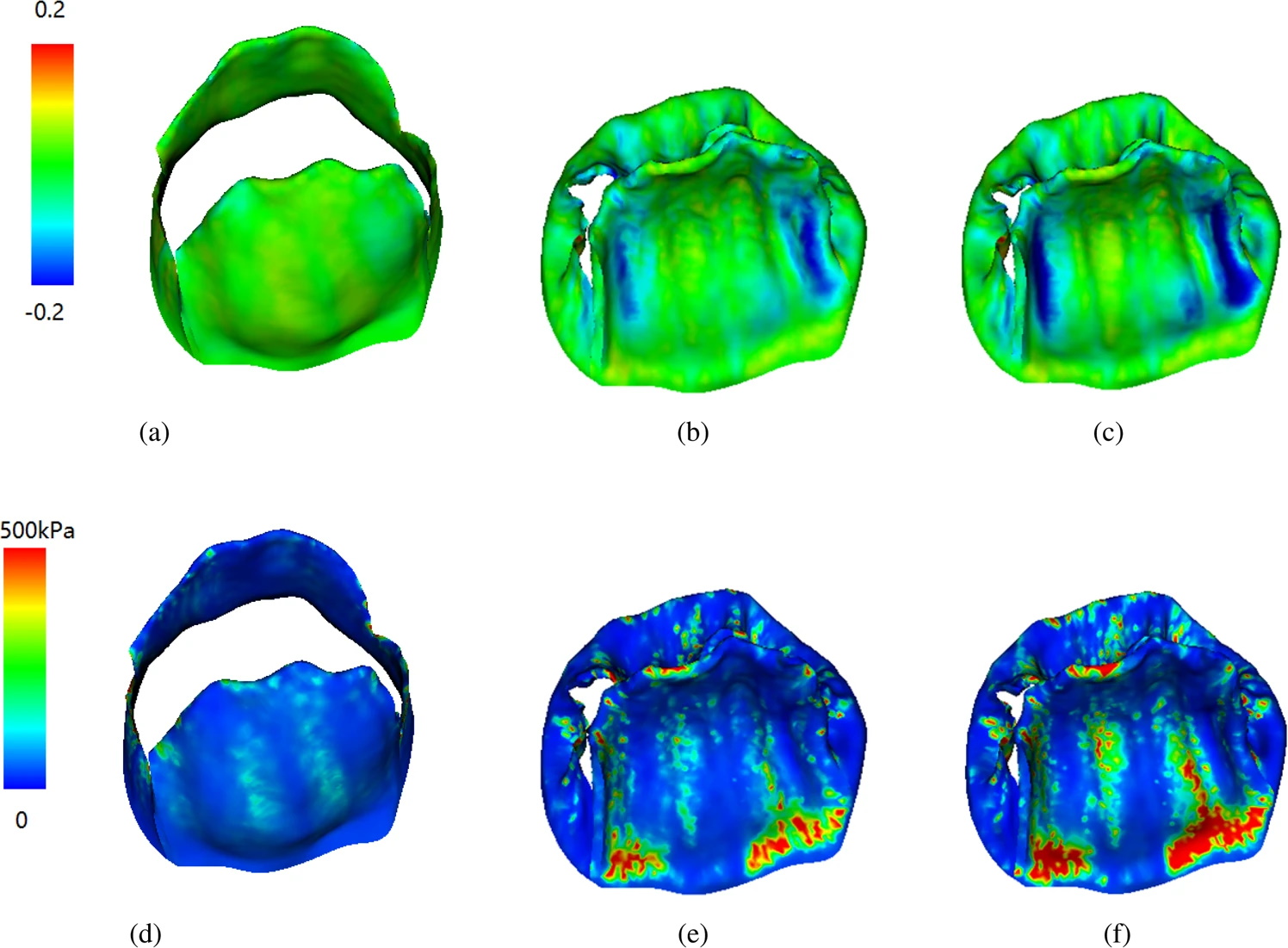
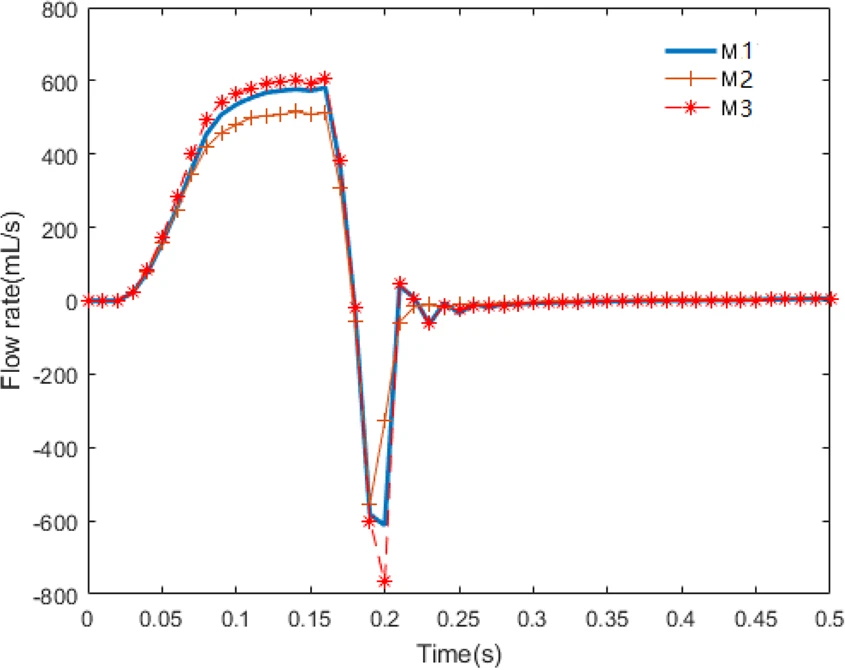
One of the most interesting findings was that the choice of leaflet constitutive law changed several aspects of the simulated mitral valve dynamics. The different laws produced differences in transvalvular flow, closure regurgitation, and valve orifice area, even though all three leaflet models could fit the mechanical data reasonably well.
That is a useful reminder for anyone working in mitral valve fluid-structure interaction. A good fit to experimental stress-strain data does not automatically mean that two constitutive laws will behave the same in a dynamic FSI setting. Small differences in material representation can propagate into meaningful differences in flow and closure behaviour.
The study ultimately found that one leaflet constitutive law produced a larger orifice area when the valve was open, a smaller orifice area when the valve was closed, and lower regurgitant closure flow than the alternatives. In practical terms, that made it the more suitable choice for this mitral valve FSI model.
Why the chordae tendineae model also mattered
The paper did not stop at the leaflets. It also compared two material laws for the chordae tendineae, including a linear model and an exponential model. While the overall deformation patterns were similar, the chordae constitutive choice still affected simulated valve behaviour, especially closure regurgitation. The exponential model produced lower regurgitant flow, suggesting tighter valve closure.
That is an important detail for mitral valve biomechanics because it shows that the supporting structures matter too. The valve is not just a leaflet problem. Chordae material behaviour can influence how well the valve coapts and how effectively it limits backward flow.
Experimental mechanics and FSI modelling work best together
One of the strongest points in this study is the way it combines static tissue testing with dynamic computational modelling. The authors explicitly show that experimental mechanical data are necessary for constitutive fitting, but that FSI simulation is necessary to judge whether those constitutive laws produce realistic dynamic behaviour under physiological conditions.
That is why this paper works so well as an example of experimental validation of FSI models. It does not treat simulation and mechanics as separate tracks. Instead, it uses them together to identify material laws that are better suited to predicting valve function.
For readers interested in extracellular matrix and valve structure-function relationships, our post on venous valve tissue mechanical properties and ECM is also relevant.
Why this matters for heart valve research
The broader implication is that constitutive law selection is not a minor technical detail. In heart valve simulations, it can influence how the model predicts opening area, flow jet behaviour, and regurgitation. That matters for basic biomechanics research, but it also matters for translational work related to valve disease, repair strategies, and device design.
For that reason, this paper is a strong anchor post for heart valve biomechanics and computational modelling audiences. It shows that experimentally informed constitutive laws improve the physiological relevance of mitral valve simulations, and that BioTester-based biaxial testing can play a meaningful role in that workflow.
For another dynamics-focused read, see cardiac tissue disease modeling.
Final thoughts
This study is a strong example of how mitral valve biomechanics can be studied by combining experimental tissue mechanics with fluid-structure interaction simulation. The BioTester provided biaxial mechanical data for mitral valve tissue, and those data helped inform which leaflet constitutive laws were suitable for dynamic modelling. From there, the simulations showed that constitutive law selection changed clinically relevant outputs such as valve closure behaviour, regurgitation, and orifice area.
For researchers working in fluid-structure interaction mitral valve modelling, that is the central takeaway: experimental fitting is necessary, but dynamic validation matters just as much. A constitutive law should not only match tissue mechanics on paper. It should also support realistic valve behaviour in motion.
Read the full publication here: Some Effects of Different Constitutive Laws on FSI Simulation for the Mitral Valve
To learn more about the instrument used for leaflet testing, visit the CellScale BioTester benchtop mechanical tester page.