Why regional differences matter in skeletal muscle mechanics
Muscle is easy to describe in broad terms, but it does not behave like one perfectly consistent material from end to end. Two samples taken from different parts of the same muscle can respond differently when they are stretched or held under load. One region may resist deformation more. Another may relax stress faster.
For work on skeletal muscle mechanics, that regional view is useful because it brings structure back into the discussion. Muscle behaviour is shaped by fiber layout, extracellular matrix, and previous loading or immobilization. Looking region by region can reveal patterns that disappear when everything is reduced to one average value.
What skeletal muscle mechanics actually measure
Most questions in skeletal muscle mechanics come back to one basic point: how does the tissue behave during loading? That can include:
-
how stiff the tissue is in different regions
-
how it behaves when loaded in different directions
-
how much stress it loses when held at a fixed stretch
-
how fibrosis, immobilization, or remodelling change passive behaviour
-
how structure affects the way force is transferred through the tissue
Researchers can learn a lot from imaging and computational models, but direct testing answers a different kind of question. It shows how the tissue actually responds during a defined experiment. That matters when the goal is to compare regions or spot mechanical changes that do not show up clearly in anatomy.
If you want a broader introduction to how soft tissues and biomaterials are mechanically characterized, see our guide to mechanical testing of biomaterials.
Regional muscle stiffness is linked to tissue structure
Regional variation in stiffness is usually rooted in structure. Fiber orientation, extracellular matrix content, fascicle arrangement, and collagen organization all influence how a local region of muscle carries load. If one area behaves differently from another, that difference often reflects a real structural distinction rather than simple experimental noise.
This becomes especially important when muscle has been immobilized or has undergone disease-related remodelling. A shift in endomysial or perimysial structure can change more than just the initial resistance to stretch. It can also alter how the tissue behaves over time. Mechanical testing is useful here because it helps connect those structural changes to measurable mechanical consequences.
Why anisotropy matters in muscle tissue mechanics
Skeletal muscle is anisotropic. In plain terms, that means it does not respond the same way in every direction. That is not surprising once you consider how muscle is built. Fibers are aligned, connective tissue is organized, and the matrix surrounding the fibers does not contribute equally in all directions.
Because of that, the loading mode matters. A uniaxial test can still tell you a great deal, but it does not always capture the full picture. In many cases, biaxial mechanical testing gives a more realistic view of how regional muscle tissue handles multidirectional loading and transfers stress through a structured soft tissue network.
That is one reason biaxial approaches are so helpful in this area. They move the analysis closer to the way real tissue behaves rather than reducing muscle to a single-direction material response.
Viscoelastic muscle behaviour adds another layer
Muscle is not just directional. It is also time-dependent. Stretch a sample and hold it, and the stress can drop with time. Load it repeatedly, and its response may shift from cycle to cycle. That kind of behaviour is part of normal soft tissue mechanics, but it can also change after fibrosis, injury, disuse, or recovery.
This is where viscoelastic muscle behaviour becomes important. Two tissues may look similar if you only compare an early stiffness value, yet behave quite differently when you track relaxation or repeated loading. That is why stress relaxation testing and related time-dependent methods are so useful in muscle research. They help separate a tissue that is simply stiff from one that has been mechanically altered in a deeper way.
What recent research themes show
Recent work in musculoskeletal tissue engineering and mechanics points to a much more useful way of framing this topic than the original broad overview. Looking across muscle-focused studies and related soft tissue work, a few themes keep appearing.
1. Skeletal muscle mechanics are region-specific
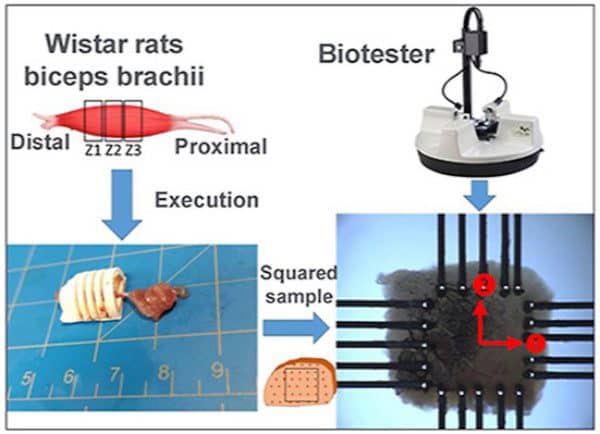
Muscle tissue can show different stiffness and relaxation behaviour depending on where it is sampled. Proximal, medial, and distal regions should not automatically be treated as mechanically interchangeable, especially after immobilization or remodelling. For example, this study on skeletal muscle immobilization and regional anisotropic viscohyperelastic properties examined how different muscle zones responded to equibiaxial relaxation testing with our BioTester and showed that immobilization changed viscoelastic behaviour while regional location influenced hyperelastic response.
2. Immobilization changes more than just stiffness
Immobilization-related remodelling can affect anisotropy, relaxation behaviour, and matrix organization all at once. In practice, the biggest change is not always a single modulus value. Sometimes the more important shift is in how the tissue loses stress over time or how it dissipates load during testing.
3. Fibrosis and remodelling affect passive muscle behaviour
As collagen organization and connective tissue content change, passive muscle behaviour can shift in meaningful ways. That is one reason mechanical testing is so relevant in studies of fibrosis, disuse, and recovery. It gives researchers a way to connect tissue remodelling with functional mechanical changes instead of relying on histology alone.
4. Mechanical characterization supports regenerative design
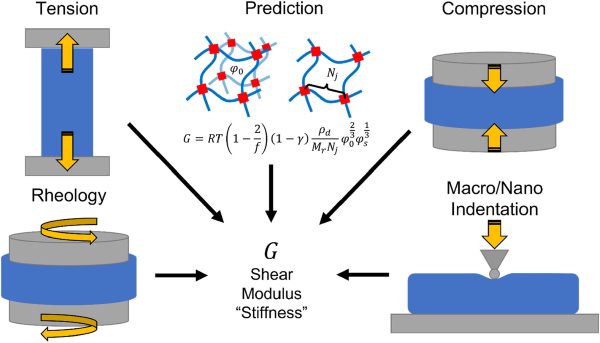
Mechanical testing also plays a practical role in skeletal muscle engineering. Researchers use compression, tensile, or micro-mechanical tests to check whether a scaffold or engineered construct is mechanically reasonable for the intended application. If a material is far too soft, too stiff, or too inconsistent, testing usually reveals that quickly.
For a related example in load-bearing musculoskeletal tissue, read our post on tendon scaffold mechanical testing under intermittent loading.
How the BioTester fits this kind of research
For studies centred on soft tissue anisotropy and regional behaviour, the CellScale BioTester is a strong fit because it supports controlled soft tissue testing in loading configurations that are relevant to these questions. That is particularly useful in work on regional variation in the mechanical properties of skeletal muscle, where equibiaxial testing was used to compare distal, middle, and proximal muscle regions and showed that measured stiffness depended strongly on sample location.
In muscle applications, that can include planar loading, stress relaxation protocols, and other approaches used to study passive tissue response under hydrated conditions.
That makes the BioTester especially useful when researchers want to measure:
-
regional muscle stiffness
-
biaxial mechanical testing response
-
stress relaxation testing
-
anisotropy in soft musculoskeletal tissues
-
passive remodelling associated with fibrosis or immobilization
Used well, this kind of testing helps move the discussion beyond simple bulk stiffness. It gives researchers a better view of how structure, directionality, and time-dependent behaviour come together in real tissue.
Why this matters for rehabilitation and tissue engineering
A better understanding of skeletal muscle mechanics has clear practical value. It can support:
-
improved models of immobilization-induced remodelling
-
better interpretation of fibrosis-related mechanical changes
-
more realistic musculoskeletal tissue models
-
scaffold and biomaterial design for muscle regeneration
-
more targeted comparisons between healthy and remodelled tissues
It also changes how people think about muscle as a test material. If different regions behave differently, then rehabilitation studies, engineered tissues, and disease models may need to account for that variation instead of depending on one average number to describe the whole muscle.
If your work involves smaller engineered tissues or mechanically sensitive samples, you may also be interested in our article on micro-testing cell clusters.
Final takeaway
A more useful way to look at this subject is through skeletal muscle mechanics. What matters is not just that variation exists, but what that variation means mechanically. If one region is stiffer, relaxes differently, or carries load another way, that can change how the tissue is interpreted in research and testing.