What does al dente actually mean in mechanical terms?
People usually describe it as pasta that is firm to the bite, but that still leaves some room for interpretation. If you wanted to compare pasta texture more objectively, you could stop guessing and run a pasta tension test instead.
That is exactly what we did here. Three pasta samples cooked for different lengths of time were tested using the CellScale UniVert to compare how cooking duration changed stiffness, stretch, and failure behaviour. It is a lighthearted example, but the testing approach is real. The same basic idea is used in research and teaching labs to study soft materials, polymers, fibres, and biological samples.
If you want more background on the method itself, see our page on Tensile Testing.
Setting up the pasta tension test
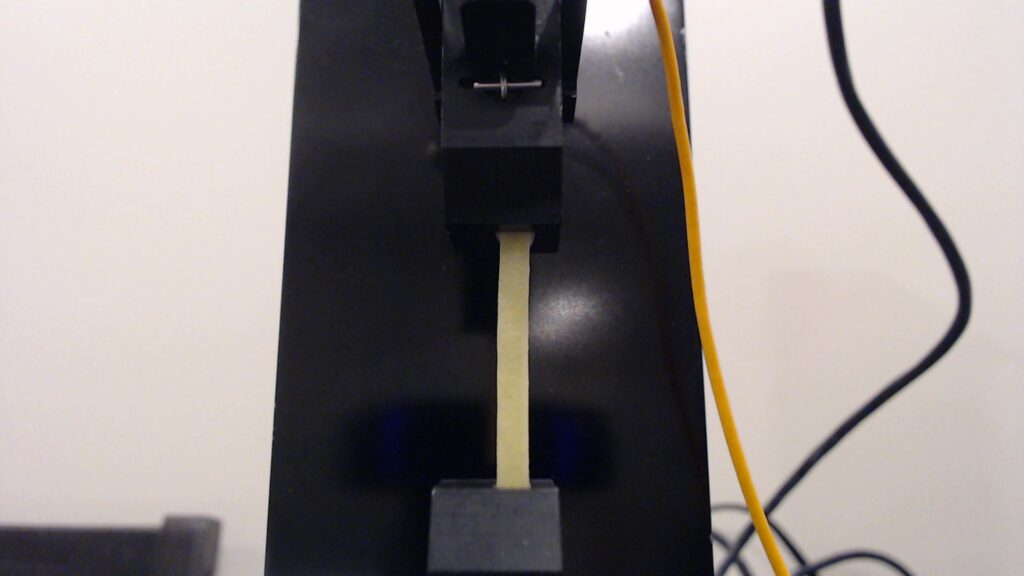
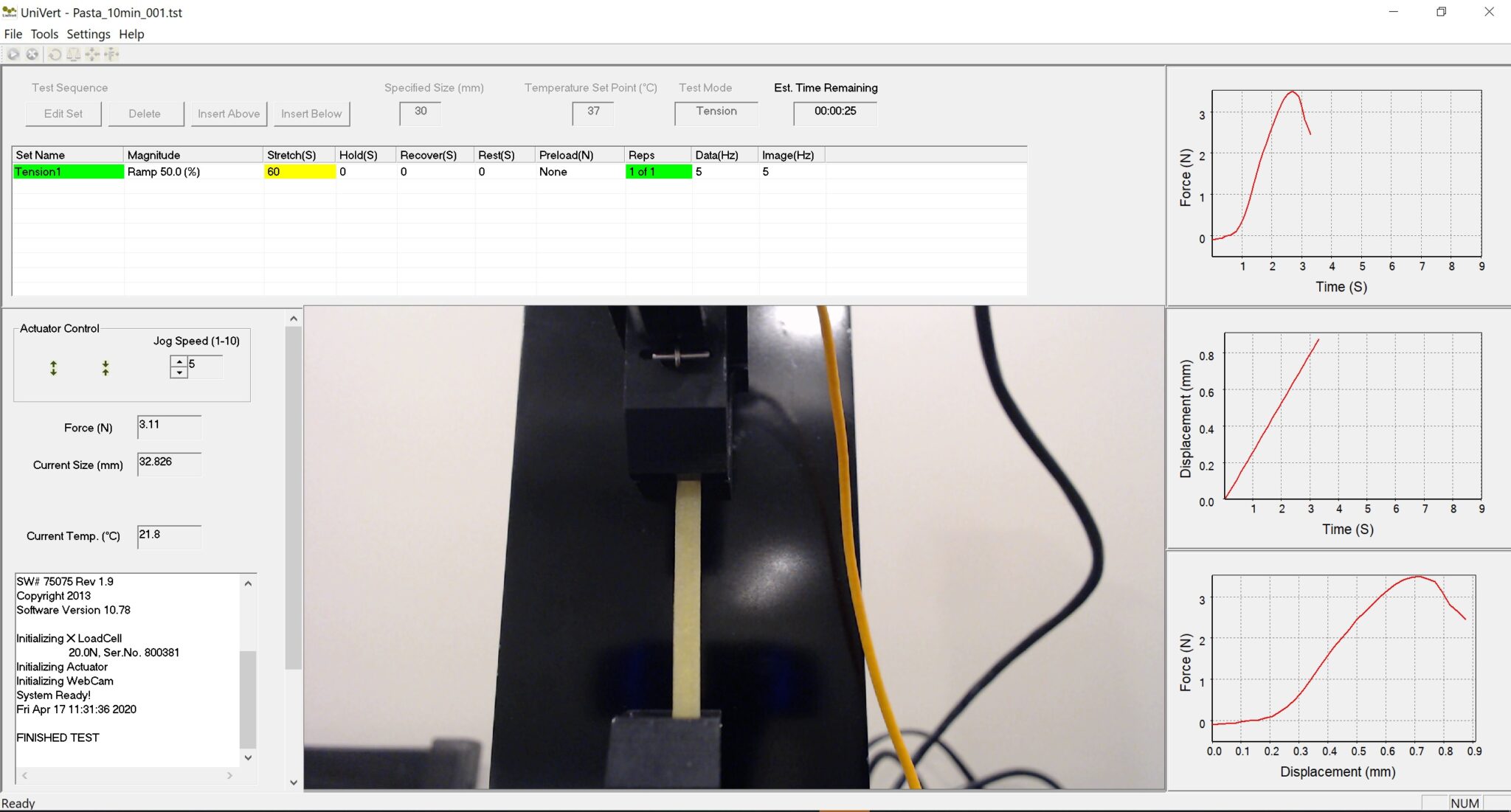
For this demo, three pasta samples cooked for different durations were mounted in the UniVert and stretched in uniaxial tension. Each sample was clamped gently to avoid damaging it before the test even began. That part matters more than people sometimes expect. If the sample slips or breaks at the grips, the data become much harder to trust.
This kind of setup is a simple example of uniaxial tensile testing. A sample is pulled in one direction while the system records force and displacement. From there, you can compare how different samples respond under the same loading conditions.
What the UniVert measures during testing
Once the sample is mounted, the software runs a defined protocol and records force and displacement in real time. That raw data are what make the test useful. Even with something as familiar as pasta, the response is easier to compare once it is measured instead of judged by feel alone.
In a basic tension test like this, the most direct outputs are:
-
force
-
displacement
-
sample extension before failure
Those values can then be used for further calculations, especially if you know the original specimen geometry.
From force-displacement data to a stress-strain curve
Force and displacement data are only the starting point. Once you account for sample dimensions, you can convert those results into stress and strain. That gives you a stress-strain curve, which is one of the most common ways to compare how materials behave mechanically.
From that curve, you can estimate values such as:
-
stiffness
-
ultimate stress
-
ultimate strain
-
Young’s modulus
This is one reason the pasta example works so well as an educational demo. It takes a familiar object and shows how a standard mechanical test can turn a subjective idea like “firmness” into something measurable.
What the pasta results showed
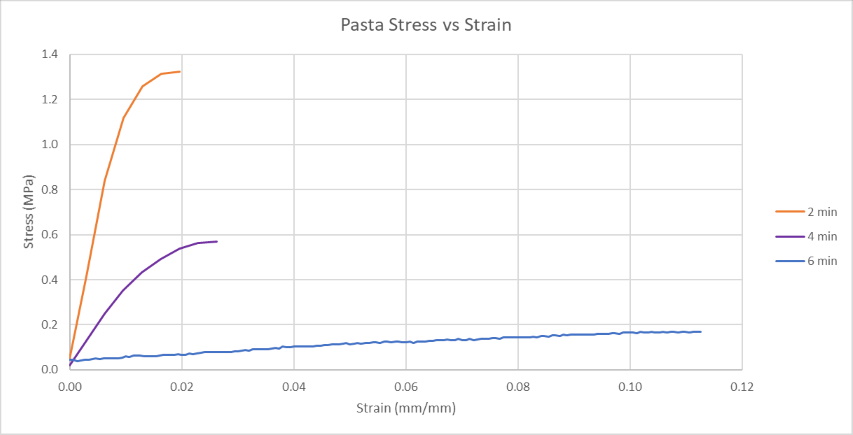
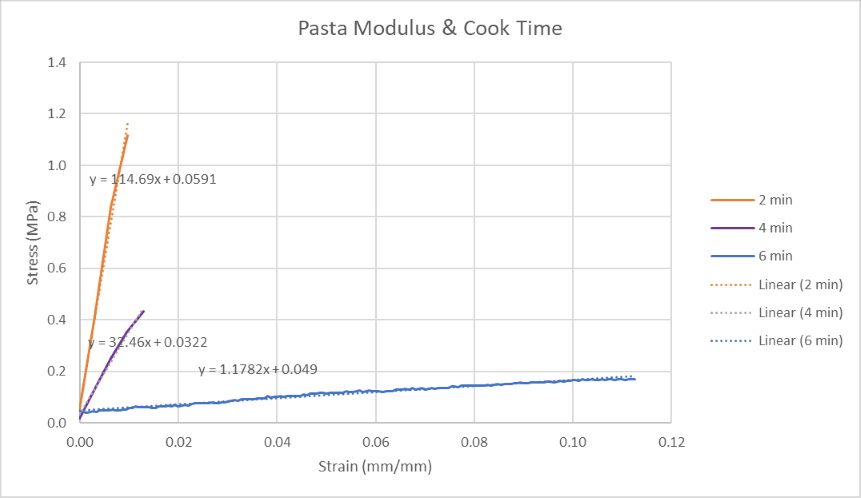
In this test, the shortest-cooked pasta sample, the 2-minute sample, behaved as the stiffest of the three and reached the highest ultimate stress. As cook time increased, the pasta became less stiff and more stretchable before failure.
That pattern makes intuitive sense. Cooking changes the internal structure of the pasta, so the mechanical response shifts as well. In simple terms, longer cook times made the samples easier to deform and more capable of stretching before breaking.
The graph also showed that ultimate strain increased with cook time, which means the softer samples deformed more before failure. That gives a useful mechanical way to think about texture. A firmer pasta resists deformation more strongly, while a more cooked pasta stretches further under load.
So what counts as al dente?
For this set of samples, we called 6 minutes the al dente condition. It was a practical middle ground between a very stiff undercooked sample and a softer overcooked one.
Of course, there is still some judgement involved. That is part of the fun. But the point of the demo is that texture does not have to stay completely subjective. A pasta tension test gives you a repeatable way to compare samples and define texture in mechanical terms.
Why this fun demo still matters
This post is playful, but the method is not a gimmick. The same uniaxial tensile testing approach is routinely used to characterize hydrogels, tissues, polymers, and fibres in research and teaching labs. That is what makes this kind of demo useful. It shows the logic of a real mechanical test in a way that is easy to understand.
If you are new to the topic, posts like this can be a good entry point before moving into more advanced applications and materials testing methods.
Final takeaway
A pasta tension test may not settle every argument about the perfect noodle, but it does show something important: texture can be measured. With uniaxial tensile testing, force-displacement data, and a simple Young’s modulus calculation, even a plate of pasta becomes a useful lesson in mechanical testing basics.