Intervertebral disc failure is a major area of interest in spine biomechanics because it is closely tied to disc herniation, back pain, and degenerative changes in the spine. In this biomechanical research highlight, Dr. Diane Gregory and Maxine Harvey-Burgess from Wilfrid Laurier University investigated how annulus fibrosus layers respond to mechanical loading using a bovine tail disc model. Their work combined biaxial torsion testing and uniaxial tensile testing to better understand how damage develops within the disc structure.
The study is particularly relevant because it focuses on how internal disc layers behave under loading conditions that are difficult to capture through observation alone. By examining both rotational loading and tensile behaviour, the researchers were able to identify how layer interactions within the annulus fibrosus contribute to mechanical failure. Their findings help improve our understanding of intervertebral disc mechanics and may support future work in disc injury prevention, treatment strategies, and spine biomechanics research.
Understanding the Structure of the Intervertebral Disc
The intervertebral disc plays a central role in spinal support, flexibility, and load distribution. It sits between adjacent vertebrae and helps the spine absorb compression, bending, and rotational forces during everyday movement.
Two main structural regions define the disc:
Nucleus pulposus
The nucleus pulposus is the gel-like inner core of the disc. It helps distribute pressure and contributes to the disc’s shock-absorbing function.
Annulus fibrosus
Surrounding the nucleus pulposus is the annulus fibrosus, a layered outer structure composed of fibrous lamellae. This region provides containment, tensile resistance, and structural stability. Because the annulus fibrosus experiences complex tensile and torsional loads, understanding how its layers deform and fail is essential in intervertebral disc biomechanics.
What the Researchers Tested
A key strength of this study was its use of cow tail intervertebral discs as a model for investigating disc mechanics. These specimens allowed the researchers to study how disc layers respond under controlled loading conditions while preserving important structural features.
The team focused on two main mechanical approaches:
-
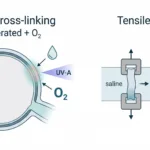
Biaxial torsion testing to evaluate how the annulus fibrosus responds to rotational loading
-
Uniaxial tensile testing to examine the strength and failure behaviour of annulus fibrosus tissue layers
In addition to these mechanical tests, the researchers used histological analysis to examine structural damage within the tissue. This combination of testing methods made it possible to connect measured mechanical response with internal tissue-level changes.
Key Findings in Intervertebral Disc Mechanics
One of the most important findings from the study was that failure was not simply a matter of the annulus fibrosus layers separating cleanly from one another. Instead, the research pointed to internal damage developing within the annulus fibrosus lamellae as a major contributor to failure under torsional loading.
This matters because disc herniation and related spinal injuries are often associated with complex internal damage mechanisms rather than one single visible structural defect. By showing that the bond between annulus fibrosus layers demonstrates notable resilience while internal layer damage still accumulates, the study adds important detail to how intervertebral disc failure may begin and progress.
These findings improve the biomechanical understanding of spinal disc injury and help refine how researchers think about disc degeneration, torsional overload, and annulus fibrosus damage.
Mechanical Testing Methods Used in This Study
Mechanical testing was central to this research because the question was fundamentally about how disc tissues respond to load.
Biaxial torsion testing
The researchers used the CellScale BioTester to perform biaxial torsion testing. This allowed them to apply controlled rotational loading and study how the annulus fibrosus behaved under torsional stress. Torsion testing is especially relevant for intervertebral disc research because spinal discs experience twisting loads during normal and abnormal movement.
This method is valuable for studying:
-
intervertebral disc torsion mechanics
-
annulus fibrosus layer interaction
-
rotational failure mechanisms in spine biomechanics
Uniaxial tensile testing
The researchers also used the UniVert for uniaxial tensile testing. Tensile testing helped characterize the mechanical behaviour of annulus fibrosus tissue when stretched in a controlled direction. This type of test is important for understanding tissue strength, stiffness, and failure response.
In the context of spine biomechanics, tensile testing can help researchers evaluate:
-
annulus fibrosus mechanical properties
-
tissue-level failure behaviour
-
how disc components respond to directional loading
Histological analysis
Mechanical testing was paired with histological analysis so the team could examine where and how damage developed within the tissue. This added an important structural layer to the findings by showing that internal damage, rather than only interfacial separation, contributed to failure.
How This Research Uses Mechanical Testing
This study is a strong example of why mechanical testing is essential in spine biomechanical research. Without torsion testing and tensile testing, it would be difficult to isolate how disc tissues respond to specific loading modes or identify which structures are most vulnerable to damage.
Using biaxial torsion testing made it possible to study rotational loading in a controlled and repeatable way. Using uniaxial tensile testing helped the researchers assess annulus fibrosus tissue behaviour more directly. Together, these methods provided a more complete picture of intervertebral disc mechanics than either technique could provide on its own.
This combination of methods also highlights the value of selecting the right instrument for the research question. The BioTester is well suited for controlled biaxial and torsional loading of soft tissues, while the UniVert supports precise uniaxial mechanical characterization. In studies of complex tissues such as intervertebral discs, that flexibility is critical.
Why This Matters for Spine Biomechanical Research
The study by Dr. Diane Gregory and Maxine Harvey-Burgess contributes to a more detailed understanding of how intervertebral discs fail under load. Rather than treating the disc as a uniform structure, the work highlights the mechanical importance of annulus fibrosus layers and the role of internal tissue damage in disc failure.
This has broader relevance for:
-
intervertebral disc and spine biomechanics research
-
disc herniation studies
-
injury mechanism modeling
-
development of improved preventative and therapeutic strategies
By combining tissue-level mechanical testing with structural analysis, the research provides a more useful framework for understanding spinal disc injury.

Conclusion
Intervertebral disc mechanics are shaped by the interaction of complex tissue structures under compression, tension, and torsion. In this study, bovine tail disc specimens helped reveal how the annulus fibrosus responds to rotational and tensile loading, with internal tissue damage emerging as a key finding.
For researchers working in spine biomechanics, this work shows the value of combining biaxial torsion testing, uniaxial tensile testing, and histological analysis to better understand disc failure mechanisms. It also reinforces how important mechanical testing is for uncovering the structural behaviour of spinal tissues in a rigorous, measurable way.
If you’re interested in delving further into related research, you can explore the article detailing the compressive mechanical properties of the optic nerve head in rats and pigs linked here.