Chitosan hydrogel composites are attractive for implantable drug delivery because chitosan is biodegradable, biocompatible, and capable of mimicking aspects of extracellular matrix structure. The challenge is that pure chitosan is mechanically weak, which can limit how well it performs as a stable hydrogel scaffold or localized delivery platform. That is why mechanical reinforcement matters in hydrogel-based drug delivery systems. Better mechanics can help a material maintain structure, support handling, and extend release behaviour over time.
In this study, researchers from Louisiana Tech University investigated how halloysite nanotubes affected the morphology, degradation, tensile properties, swelling, drug release, antibacterial activity, and cytocompatibility of chitosan hydrogel composites. CellScale contributed to the work through the use of the UniVert, which was used for tensile testing of the hydrogel films. The results showed that halloysite reinforcement improved mechanical performance, but only within a relatively narrow concentration range.
For broader context on why this type of work matters, see our guide to mechanical testing of biomaterials.
Why chitosan hydrogel composites are useful for drug delivery
A localized hydrogel delivery system can help avoid some of the drawbacks of systemic antibiotic administration by placing the active agent directly at the target site. The paper frames this clearly: a successful implantable drug delivery material should be biocompatible, biodegradable, mechanically stable, and able to provide sustained drug release. Chitosan already offers several of those features, including biodegradability, low toxicity, and extracellular matrix-like behaviour, but it needs mechanical improvement to become more broadly useful.
That is where halloysite nanotubes become interesting. Halloysite can act both as a reinforcing filler and as a nanocontainer for sustained release of drugs and other bioactive compounds. In this study, those two functions came together in a single hydrogel system.
What the researchers tested
The team prepared chitosan hydrogel composites with chitosan concentrations from 3% to 5% and halloysite nanotube additions ranging from 1% to 5%. Some halloysite nanotubes were also loaded with gentamicin to evaluate drug release and antibacterial function. The researchers then assessed how composition changed bead shape, degradation, tensile response, swelling ratio, release behaviour, bacterial inhibition, and pre-osteoblast viability.
This broad workflow is one of the strengths of the paper. Rather than only measuring mechanics, the study links hydrogel mechanical properties to drug delivery and biological performance.
How the CellScale UniVert was used
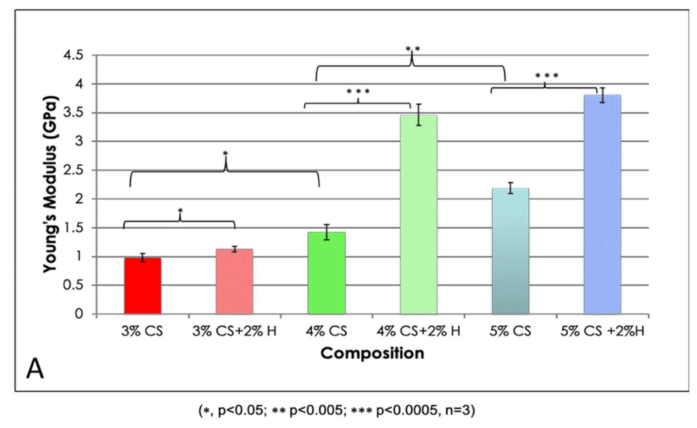
CellScale’s role in the study came through the UniVert, which was used for tensile testing of hydrogels. Crosslinked films were prepared at a consistent size and tested in uniaxial tension at 10 mm/min. Tensile stress, elongation, and Young’s modulus were then used to compare how chitosan concentration and halloysite content changed film mechanics.
This is a valuable part of the story because it connects CellScale directly to one of the paper’s key design questions: how much halloysite reinforcement actually improves chitosan performance before excess filler begins to weaken the material. That makes the study a strong example of hydrogel mechanical testing supporting biomaterial formulation decisions.
For a related hydrogel mechanics article, see our post on hydrogel stiffness measurement.
Higher chitosan content improved strength and bead structure
The morphology results showed that low-chitosan beads were more prone to collapse after lyophilization, while higher chitosan concentration produced more uniform, rounded bead shapes. The paper also notes that higher chitosan concentration was associated with smaller pore sizes and less deformable hydrogels.
The tensile data supported that structural trend. Higher chitosan concentration increased tensile stress resistance, while lower chitosan concentration gave greater elongation. In other words, as chitosan content increased, the material became stronger but less stretchable. This is a useful design tradeoff for chitosan hydrogel composites, especially when the goal is to balance handling, mechanical stability, and compliance.
Halloysite nanotubes improved mechanics, but only up to a point
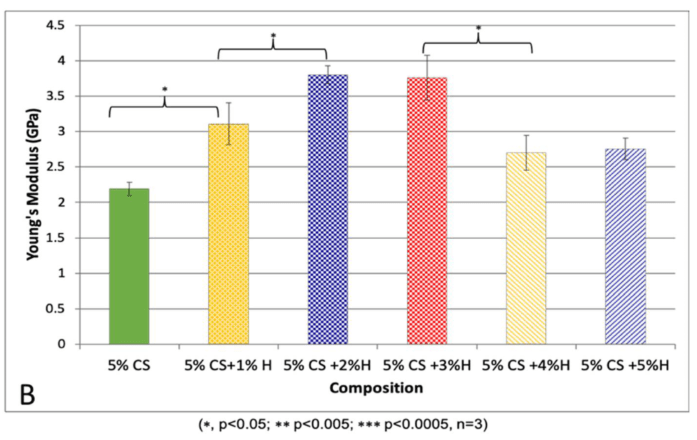
One of the most important findings in the paper is that halloysite reinforcement was not linear. Adding halloysite improved tensile behaviour and Young’s modulus at lower concentrations, but excess HNT loading reduced that benefit. The best reinforcement was observed at relatively low HNT levels, especially around the 2% range, while higher additions gradually weakened the material.
The authors suggest that this decline may be related to poor nanotube dispersion and the formation of clusters at higher HNT concentrations. Those clusters can create interfacial gaps and disrupt force transfer through the matrix, so instead of reinforcing the hydrogel they begin to undermine its original mechanical integrity. That interpretation is supported by the SEM images of the 5% chitosan films with increasing HNT content.
Degradation and swelling were shaped more by chitosan than HNT addition
The degradation study showed that all chitosan-based hydrogels degraded gradually in lysozyme solution, as expected. Chitosan concentration affected degradation rate early on, but the final weight ratios were not significantly different after 14 days. More importantly, halloysite addition did not significantly change chitosan biodegradability.
Swelling results added another layer to the story. Lower chitosan concentration produced higher swelling ratios, and halloysite addition reduced swelling. The authors interpret this as evidence that lower chitosan concentration corresponds to lower crosslink density, while HNT incorporation increases crosslink-related structural restriction. This helps explain why composition affects both mechanical performance and transport-related behaviour.
Mechanical reinforcement correlated with more sustained drug release
The paper showed that pure drug-loaded HNTs had a strong burst release, while the chitosan hydrogel composites produced a more stable and extended release profile. Higher chitosan concentration also supported longer release times at later time points.
That matters because it links drug delivery hydrogel mechanics to function. A mechanically reinforced hydrogel matrix is not just stronger to handle. It can also help modulate the release environment and support more sustained delivery. This is exactly the kind of connection that makes the study valuable for biomaterials and drug delivery audiences.
For a related biomaterial design example, see 3D Bioprinting with Methacrylated Gelatin.
The composites also showed antibacterial activity and cytocompatibility
The antibacterial tests showed that gentamicin-loaded composites inhibited both E. coli and S. aureus effectively over time, while HNT-containing hydrogels without gentamicin showed more limited inhibition, especially against S. aureus.
The Live/Dead assay also showed that the materials were cytocompatible. Pre-osteoblasts cultured on the hydrogel films remained largely viable, although cell morphology differed across formulations. The softer, lower-chitosan groups showed more wrinkling and clustering behaviour, which the authors linked to differences in substrate mechanics and surface features.
That makes the paper more than a mechanical study. It is a formulation study where structure, mechanics, release, and cell response all interact.
What this means for hydrogel drug delivery design
The main design lesson is that chitosan hydrogel composites can be improved with halloysite addition, but only within an optimal range. Too little filler does not take full advantage of reinforcement, while too much can create dispersion problems and weaken the material. At the same time, increased chitosan content improves structure and supports longer-term release behaviour.
For researchers developing injectable and regenerative biomaterials or local antibiotic delivery systems, that balance is important. Mechanical reinforcement is useful, but it has to be tuned alongside degradability, swelling, and release kinetics.
Final thoughts
This study shows why chitosan hydrogel composites are promising for localized drug delivery. By combining chitosan with halloysite nanotubes, the researchers created a hydrogel system with improved tensile properties, sustained gentamicin release, antibacterial function, and good cytocompatibility. The CellScale UniVert played a direct role in showing how composition changed mechanical response, which was central to the paper’s conclusions.
The most useful practical message is that halloysite reinforcement works best in a controlled range. Low-to-moderate HNT loading improved mechanical behaviour, while excessive addition reduced reinforcement. For hydrogel-based drug delivery systems, that kind of mechanics-release relationship is exactly what makes formulation testing worthwhile.
Read the full journal article here: The Effect of Halloysite Addition on the Material Properties of Chitosan-Halloysite Hydrogel Composites
Read about Dr Mills’ research here: Biomorph Lab
For related reading, you may also like: