A reliable bioresorbable conductive paste could solve one of the quieter but more important problems in transient electronics: how to make electrical interconnections that conduct well, print cleanly, hold their shape, and then safely disappear after the device has done its job.
That is the problem addressed in a study from researchers in South Korea, who developed an isotropic conductive paste for bioresorbable electronics using beeswax, tungsten particles, and glycofurol. The material, referred to as W-paste, was designed as a temporary interconnection material for implantable devices such as sensors, antennas, and contact pads. The paper reports that the paste achieved conductivity above 7 kS/m, could be screen printed, maintained structural integrity in aqueous conditions for the needed period, and degraded in PBS over roughly 80 days depending on geometry and test conditions.
What makes the work especially relevant for CellScale readers is that the authors did not stop at conductivity. They also studied the mechanical stability of the paste, including flexural and compressive behaviour using a CellScale UniVert, because a conductive interconnect that cracks, delaminates, or deforms unpredictably is not very useful in a temporary implant.
Why bioresorbable conductive paste matters
Bioresorbable electronics are intended to function for a limited time in the body and then dissolve, avoiding the need for surgical removal. That makes them attractive for short-term sensing, therapy, and monitoring applications. The paper points to use cases such as temporary actuators, drug delivery systems, biomarker sensors, peripheral nerve regeneration, oncology treatment, and intracranial pressure detection.
But even when the active device components are bioresorbable, the interconnection materials often remain a bottleneck. The paper makes the point that earlier interconnect materials have usually fallen short in at least one practical way. Some do not conduct well enough. Some are difficult to print or pattern cleanly. Others are too brittle, require aggressive processing conditions, or do not work well when the connection has to extend through the thickness of a device rather than just across a flat surface. Because of those tradeoffs, fully bioresorbable device stacks have remained difficult to build in a truly all-resorbable way.
That is why this study matters. It is not just proposing a new material. It is trying to close a real gap between bioresorbable device concepts and device fabrication.
What the material was made from
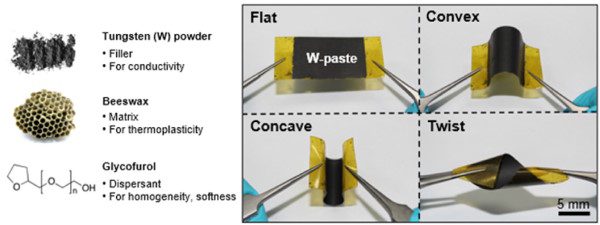
The W-paste consisted of three main components:
-
tungsten particles, used as the conductive filler
-
beeswax, used as the thermoplastic matrix
-
glycofurol, used as a dispersant and softening agent
The optimized formulation used 500 nm tungsten particles at 27 vol% with 6 vol% glycofurol in the beeswax matrix. According to the paper, this combination gave the best balance of conductivity, particle distribution, softness, viscosity, and isotropic electrical behaviour.
The authors make an important materials choice here. They specifically replaced candelilla wax, which had been used in earlier work, because it is relatively brittle. Beeswax was softer and better suited to mechanically robust interconnections. That change is a major part of why the updated paste performed better mechanically.
Why isotropic conductivity mattered
One of the central claims in the paper is that the material provides isotropic conductive paths. That matters because many conductive materials work well mainly in planar layouts, while temporary implantable devices often need nonplanar or vertical interconnections between components.
One of the more useful comparisons in the paper is the through-thickness resistance result. In the tungsten-filled paste, the resistance measured near the top of the molded sample was close to what was measured near the bottom. That was not true for the molybdenum version, where particle settling created a much less uniform structure. The tungsten formulation behaved more evenly through the bulk, which is exactly what you want when the connection cannot be treated as purely planar.
That gives the paste broader use in implantable sensors, temporary neural interfaces, and other bioresorbable interconnection materials where geometry is not always flat or simple.
Mechanical testing and why it mattered
The paper explicitly includes mechanical tests because conductivity alone is not enough. A paste used inside or on an implantable device must survive fabrication, handling, bending, aqueous exposure, and interface stresses without losing function.
The authors performed three-point bending tests and compression tests using our UniVert mechanical tester. They also measured hardness and contact angle, and they looked at cracking, particle dispersion, and deformation behaviour using microscopy.
Mechanical testing was critical to ensure the conductive composite maintained integrity during implantation and degradation. This was not an afterthought. It was part of the core material design problem.
What the mechanical results showed
The mechanical data make the material shift pretty clear. Replacing candelilla wax with beeswax made the composite much less rigid, and adding glycofurol softened it further. In three-point bending, the flexural modulus fell from about 2.64 GPa in the candelilla-based version to 622 MPa with beeswax, then to 223 MPa once glycofurol was added. Flexural strength dropped as well, but here that tradeoff was part of the point. The goal was not to make the stiffest interconnect possible. It was to make one that could bend and survive better in a soft, temporary electronic system.
Compression testing told a similar story. Adding glycofurol reduced compressive stress while increasing compressive strain, which means the paste became softer and more deformable rather than failing early as a rigid brittle composite. At 6 vol% glycofurol, the paste showed a notable increase in compressive strain compared with the glycofurol-free version.
The microscopy results help explain why. Without glycofurol, the surface showed microfractures and crazing, and the tungsten particles were more agglomerated. With glycofurol, the particles were distributed more evenly, the surface was smoother, and the paste was less prone to cracking. The images on the mechanical-properties figures in the paper make that difference very visible.
Why beeswax and glycofurol improved the material
The paper’s argument is fairly practical. Beeswax is softer and more thermoplastic than candelilla wax, which helps reduce mechanical mismatch with flexible substrates. Glycofurol then improves the material further by helping disperse the tungsten particles, reducing residual-stress-related cracking, lowering surface contact angle, and increasing softness and viscosity.
That last point is especially useful. The glycofurol-containing paste retained its shape even above the nominal melting point in some demonstrations because the added viscosity improved shape retention. So the additive was doing more than just improving conductivity. It was helping the paste stay usable as a printed and handled interconnect.
Electrical and degradation performance
The optimized paste reached conductivity above 6.4 to 7 kS/m, depending on how the results are framed in the paper, which was several times higher than the earlier comparison materials discussed by the authors. The resistivity was also low enough to place it in a useful range for temporary electronic interconnects.
The degradation behaviour is also important. A 200 μm-thick printed pattern in PBS at elevated temperature dissolved fully by about 80 days, while the authors also showed functional stability over shorter periods relevant to device use. Conductivity in PBS at 37°C was better maintained in the glycofurol-containing formulation than in the glycofurol-free version, which tended to crack and lose performance faster.
The paper also reports in vitro and in vivo biocompatibility results supporting the safety of the material as an implantable component, including cytotoxicity testing, implantation studies, and inflammatory marker analysis.
Example applications shown in the paper
The authors did a good job of showing that the material was not just mechanically and electrically plausible. They actually used it in device-style demonstrations.
The paper includes:
-
a screen-printed antenna coil
-
contact pads with line widths down to 200 μm
-
a flex sensor
-
a bioresorbable fringing-effect capacitive sensor
-
integration into a bioresorbable wireless stimulator
Those examples are valuable because they show how a bioresorbable conductive paste could support real temporary implantable electronics rather than just stand-alone material testing.
Why this research matters
This study is a strong example of how materials development for bioelectronics depends on more than one metric. High conductivity is helpful, but for implantable bioresorbable electronics, the real challenge is balancing conductivity, printability, shape retention, softness, degradation timing, and biocompatibility all at once.
The paper makes a convincing case that the beeswax-tungsten-glycofurol system moves closer to that balance than earlier brittle or less conductive bioresorbable pastes. It is also a good example of why mechanical testing belongs in these discussions. Temporary electronics still have to function as physical objects before they disappear.
Conclusion
A bioresorbable conductive paste is only useful if it can connect components reliably for the intended lifetime without introducing new mechanical or biological problems. In this study, researchers developed a tungsten-based paste in a beeswax matrix with glycofurol that combined high conductivity, isotropic electrical pathways, mechanical stability, printability, and controlled degradation. Mechanical testing using a CellScale UniVert helped show that the material was significantly less brittle and more deformation-tolerant than earlier wax-based alternatives.
For temporary implantable systems such as implantable sensors, temporary neural interfaces, and bioresorbable drug delivery electronics, that combination is what makes the material interesting. It is not just conductive. It is much closer to being usable.
Read the full publication here.