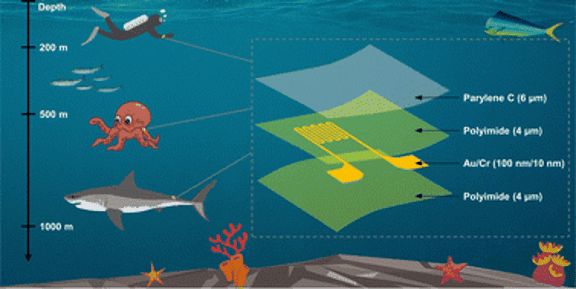
Flexible pressure sensors are becoming increasingly important in deep-sea monitoring because they can conform to complex surfaces, tolerate deformation, and support pressure measurement in demanding environments. In deep-sea applications, sensors may be integrated into underwater vehicles, robotic systems, or animal-mounted tags, where compactness, flexibility, and durability all matter.
For this type of technology, design alone is not enough. Mechanical testing of flexible pressure sensors, including evaluation of pressure response, deformation behaviour, durability, and hysteresis, is essential for validating performance under deep-sea conditions. This is where material characterization and controlled mechanical loading become directly relevant to sensor development.

Why Flexible Pressure Sensors Matter in Deep-Sea Monitoring
The deep sea presents a mechanically challenging environment. Sensors used in these settings must operate under high hydrostatic pressure, repeated loading, and unpredictable movement, while continuing to generate reliable data. This makes flexible pressure sensors especially attractive because they can adapt more readily to curved or dynamic surfaces than rigid sensor designs.
In deep-sea monitoring, flexible pressure sensors may be used in:
-
underwater robotics
-
autonomous underwater vehicles
-
diver equipment
-
marine animal tags
-
environmental monitoring platforms
Because these devices are often exposed to extreme conditions, their mechanical response must be understood as carefully as their electrical behaviour.
Mechanical Testing of Flexible Pressure Sensors
A critical part of developing flexible pressure sensors is determining how the sensor materials and structures behave under load. In deep-sea applications, that means understanding not only sensing performance but also how the device deforms, recovers, and maintains function under pressure.
Mechanical testing of flexible pressure sensors can help researchers evaluate:
-
pressure-induced deformation
-
structural durability
-
hysteresis during loading and unloading
-
repeatability of response
-
material stability under repeated cycles
-
mechanical limits of sensor architectures
This is especially important for flexible sensors made from polymers, thin films, patterned conductive layers, and other compliant materials that may experience significant strain in use.
Materials Used in Flexible Pressure Sensors

Material selection is central to the performance of flexible pressure sensors. These devices often rely on compliant materials that allow bending and deformation while still supporting stable signal generation.
Examples of materials and features relevant to flexible pressure sensors include:
-
polymer films such as Parylene C
-
thin conductive films such as patterned gold electrodes
-
soft dielectric layers
-
elastomeric structures
-
multilayer flexible sensor stacks
In deep-sea settings, these materials must do more than enable flexibility. They must also resist chemical exposure, maintain integrity under hydrostatic pressure, and continue functioning over extended deployment periods.
This is why material mechanics matter so much. If a flexible sensor performs well electrically but deforms unpredictably or fails mechanically, its usefulness in deep-sea monitoring is limited.
Pressure-Induced Deformation and Sensor Design
One of the most important design questions for flexible pressure sensors is how the structure responds to pressure-induced deformation. Sensor geometry affects not only flexibility but also stress distribution, sensitivity, and long-term durability.
For example, a rectangular sensor design may simplify integration, while more symmetric geometries may distribute stress more evenly. Pattern design also matters. Flexible architectures often depend on structural features that allow bending or stretching while reducing the risk of mechanical failure.
In practical terms, the design of flexible pressure sensors must balance:
-
conformity to surfaces
-
sensitivity to pressure changes
-
resistance to deformation damage
-
stable signal behaviour
-
long-term reliability
Mechanical characterization is important because it helps researchers determine whether the sensor geometry actually performs as intended under realistic loading conditions.
Sensor Durability and Hysteresis
For deep-sea applications, sensor durability and hysteresis are not secondary concerns. They are central performance criteria.
Durability
A sensor intended for ocean deployment must tolerate high pressure, motion, and repeated use without structural breakdown. This includes resistance to fatigue, material damage, and long-term drift caused by environmental exposure.
Hysteresis
Low hysteresis is important because it affects how consistently a sensor returns to baseline after pressure changes. Inaccurate recovery can reduce measurement reliability and make it harder to interpret sensor output in dynamic underwater conditions.
By focusing on sensor durability and hysteresis, researchers can better evaluate whether flexible sensor designs are suitable for prolonged operation in harsh environments.
Functional Performance of Flexible Pressure Sensors
The usefulness of flexible pressure sensors in deep-sea monitoring depends on more than their ability to survive. They also need to deliver meaningful and repeatable measurements.
Important functional considerations include:
Pressure response
The sensor must detect changes in pressure accurately across the expected operating range.
Sensitivity
The design should allow the sensor to respond clearly to pressure variation without excessive noise or instability.
Reliability
Performance should remain consistent over time and across repeated loading events.
Power efficiency
For long-duration or remote deployments, power use must remain low enough for practical operation.
Mechanical testing supports all of these goals by helping researchers understand how material and structural behaviour influences sensing reliability.
Applications of Flexible Pressure Sensors in Ocean Research

Flexible pressure sensors are relevant to several areas of ocean and marine technology research.
Underwater robotics
Sensors can be integrated into robotic platforms to provide feedback on pressure conditions, surface interaction, or deformation in soft robotic components.
Autonomous underwater vehicles
Compact flexible sensors can support data collection while fitting into constrained geometries and tolerating movement.
Animal-borne monitoring
Flexible sensor systems used in marine animal tags can reduce interference with natural movement while collecting environmental and behavioural data.
Diver systems and wearable platforms
In some cases, flexible sensor designs may support improved conformity and usability in wearable marine equipment.
These use cases reinforce why mechanical testing of flexible pressure sensors is important. The device must perform reliably not only in the lab but also in physically demanding field conditions.
How CellScale Supports This Type of Research
For researchers developing or validating flexible pressure sensors, mechanical characterization can play an important role in material and prototype evaluation. CellScale systems can support in-lab testing workflows where researchers need to measure force response, deformation behaviour, and durability of flexible materials and structures.
This is particularly relevant for applications involving:
-
soft polymers and elastomers
-
thin flexible membranes
-
wearable bioelectronics
-
soft robotic materials
-
pressure-responsive structures
In these workflows, mechanical testing helps bridge the gap between sensor design and functional validation.
Why Mechanical Testing Matters for Flexible Pressure Sensors
The development of flexible pressure sensors depends on understanding how materials and structures behave under realistic mechanical conditions. In deep-sea applications, that includes high pressure, repeated deformation, and long-term exposure to demanding environments.
This is why mechanical testing of flexible pressure sensors is so valuable. It helps researchers determine whether a sensor is only theoretically promising or actually robust enough for real-world use. By measuring deformation behaviour, hysteresis, and durability, researchers can refine designs and improve confidence in device performance.
For CellScale’s audience, this topic is especially relevant because many advanced sensor systems depend on soft and flexible materials whose mechanical behaviour must be characterized just as carefully as their sensing output.
Conclusion
Flexible pressure sensors offer strong potential for deep-sea monitoring because they combine adaptability, compact form, and the ability to function in mechanically complex environments. Their success, however, depends not only on advanced materials and electronics but also on reliable mechanical performance.
By focusing on mechanical testing of flexible pressure sensors, researchers can better understand pressure-induced deformation, durability, and hysteresis, all of which are essential for developing sensors that can operate reliably under deep-sea conditions.