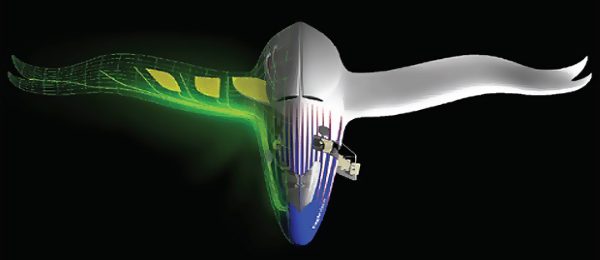
Morphing wing concepts place unusual demands on materials. A wing skin has to stretch enough to accommodate shape change, but it also has to hold a smooth aerodynamic surface and resist unwanted deformation under load. That combination is difficult to achieve, which is why the mechanical behaviour of candidate elastomers matters as much as the wing concept itself.
In a study from Khalifa University, researchers evaluated latex as a morphing wing skin material using multiaxial mechanical testing. Uniaxial, pure shear, biaxial, and equibiaxial tests were performed with the CellScale BioTester to reproduce the different stress states that can develop in monomorphing and polymorphing wings. The team also examined strain rate, sheet thickness, and aspect ratio, along with key viscoelastic effects such as hysteresis loss and stress relaxation.
Why morphing wing skin materials are difficult to design
A morphing wing skin has to do two things at once. It needs low in-plane stiffness so the structure can morph without excessive actuation force, and it needs enough out-of-plane support to preserve aerodynamic shape under loading. The paper frames this as one of the central design challenges in morphing aircraft, especially as the field shifts from monomorphing concepts with one degree of freedom to polymorphing concepts with two or more.
That shift matters because the skin no longer sees just one simple loading mode. Depending on how the wing changes shape, the material may experience something closer to pure shear, biaxial extension, or even equibiaxial loading. The authors make the point clearly: using material data from only one deformation mode can lead to poor modeling assumptions when the real application is multiaxial.
How the latex was tested
The study used our BioTester to test latex under four deformation modes up to about 80% strain:
-
Uniaxial
-
Pure shear
-
Biaxial
-
Equibiaxial
The BioTester setup included four actuators, biaxial grips with tungsten tines, synchronized imaging, and a 5 N load cell for soft-material force measurement. The paper also used an Instron universal testing machine for uniaxial tests up to 500% strain so the researchers could study large-strain behaviour and strain-rate effects over a wider range.
The latex sheets came in three thicknesses: 0.25 mm, 0.50 mm, and 1.05 mm. The authors also varied aspect ratio in uniaxial tests and tested strain rates chosen to reflect practical morphing-wing conditions.
Why multiaxial testing mattered in this study
One of the strongest parts of the paper is that it does not treat latex like a simple tensile material. The authors show that the same sheet behaves differently depending on how it is loaded.
Under uniaxial loading, the specimen is free to contract laterally. Under pure shear, lateral contraction stays small. Under biaxial loading, the sheet is stretched in both directions, with the Y-direction strain rate set at half the X-direction rate. Under equibiaxial loading, both directions are stretched at the same rate. The images and strain maps in the paper make this difference visible, especially on pages 4 through 7 where the deformation states are shown directly.
That distinction is important for morphing wing research because a skin used for span extension alone does not face the same loading state as a skin used for coupled span and camber morphing.
What the study found about stiffness and loading mode
The clearest result is that loading mode changed the mechanical response significantly.
At a given strain in the X direction:
-
Uniaxial loading produced the lowest stress
-
Pure shear produced higher stress than uniaxial
-
Biaxial loading increased stress further
-
Equibiaxial loading produced among the highest responses
-
The biaxial Y direction showed the highest secant modulus in the reported comparisons
The authors explain this in terms of how much constraint is placed on the polymer chains and entanglements. When the sheet is free to contract laterally, as in uniaxial loading, the response is softer. When deformation is imposed in both axes, the material becomes effectively stiffer because chain stretching is constrained in more than one direction.
This is one reason the paper is useful beyond a simple product mention. It shows why biaxial testing of elastomers is necessary when the application itself is multiaxial.
Hysteresis loss and stress relaxation
The paper places a lot of emphasis on viscoelastic behaviour, which makes sense for morphing structures. If the skin dissipates too much energy or relaxes too much under load, it can increase actuation demands and reduce performance repeatability.
Two findings stand out:
-
Pure shear produced the lowest hysteresis loss and lowest stress relaxation
-
Equibiaxial loading produced the highest hysteresis loss and highest stress relaxation
That pattern matters. For a morphing wing designer, it suggests that loading paths resembling pure shear are mechanically less penalizing than those involving stronger biaxial coupling. The results table in the paper shows this consistently across the tested thicknesses.
The authors also discuss why hysteresis occurs in latex. During loading and unloading, the polymer chains and entanglements reorient and exchange heat with the surroundings, producing dissipative loss. In practical terms, that means not all deformation energy is recovered cleanly.
Effect of thickness
Thickness had a meaningful effect across the study. As thickness increased from 0.25 mm to 1.05 mm:
-
stress at a given strain generally decreased
-
hysteresis loss decreased
-
stress relaxation decreased
-
secant modulus also decreased in the reported comparisons
The paper attributes this partly to the greater number of chains and crosslinks in thicker material, which changes how the material deforms and dissipates energy. For morphing wing design, that creates a tradeoff. Thicker sheets may reduce some viscoelastic penalties, but they also influence actuation and structural response.
Effect of strain rate
The authors also tested latex at different strain rates and found a clear rate dependence.
As strain rate increased:
-
stress at a given strain increased
-
hysteresis loss increased
-
secant modulus increased
This is an important practical result. Latex becomes effectively stiffer when actuated more quickly, because the viscoelastic network has less time to relax. In the context of morphing wings, that means faster actuation can come with a real mechanical cost. The paper specifically notes that lower strain rates are advantageous when lower hysteresis, lower modulus, and lower actuation force are desired.
Effect of aspect ratio
Aspect ratio was also found to matter. In the uniaxial tests, increasing the specimen aspect ratio led to:
-
lower stress at a given strain
-
lower hysteresis loss
-
lower secant modulus
The paper defines aspect ratio here as specimen length divided by width, with width held constant while length changed. The interpretation is straightforward: geometry influences how many chains and crosslinks are available for stretching and how the material distributes deformation. For morphing skin design, that means geometry is not just a mounting detail. It changes the measured mechanical behaviour.
What this means for monomorphing versus polymorphing wings
The authors note that monomorphing applications, such as span extension alone, are often mechanically similar to pure shear. Since pure shear showed lower hysteresis losses and lower stress relaxation, latex appears more favorable in that type of application.
By contrast, polymorphing applications can impose biaxial loading, which increases stiffness and introduces more demanding viscoelastic behaviour. The authors specifically state that less actuation force is usually required in monomorphing applications because stiffness is lower there than in the biaxial cases relevant to polymorphing.
They also relate suitability to the broader morphing categories discussed in the paper: planform morphing, out-of-plane morphing, and airfoil morphing. Their conclusion is that planform morphing appears to be the most promising use case for latex skin, while airfoil morphing is likely to require higher actuation force because it involves lower-strain, higher-rate conditions where the material is mechanically less forgiving.
Why this research matters
This paper is useful because it gives a fuller mechanical picture of latex rather than treating it as a generic flexible membrane. The results show that morphing wing skin materials cannot be evaluated with a single tensile test and a simple stress-strain curve. Loading mode, thickness, strain rate, and geometry all change the response, and those changes matter directly for actuation force, energy loss, and design suitability.
For CellScale readers, it is also a strong example of where the BioTester fits into advanced materials research. The study depended on multiaxial testing to capture behaviour that would have been missed in a uniaxial-only workflow.
Conclusion
Latex remains an interesting candidate for morphing wing skin applications, but this study shows that its usefulness depends strongly on how the skin is expected to deform. Using the CellScale BioTester, the researchers demonstrated that pure shear, biaxial, and equibiaxial loading produce meaningfully different mechanical behaviour, with pure shear showing the lowest hysteresis and relaxation penalties and biaxial loading producing the highest stiffness in the reported comparisons. They also showed that higher strain rate increases hysteresis and stiffness, while greater thickness and aspect ratio tend to reduce viscoelastic losses.
Taken together, the results suggest that latex is better suited to monomorphing and planform-type applications than to more mechanically demanding polymorphing cases. That makes this paper a useful reference point not only for aerospace morphing skins, but also for other adaptive structures that rely on soft elastomeric materials under multiaxial load.
Read the full article here.