Rotator cuff biomechanics is central to understanding how tendon tears develop, progress, and respond to rehabilitation loading. In a study presented at the Orthopaedic Research Society, researchers investigated how small- and medium-sized rotator cuff tears affect internal tendon strain using finite element modeling informed by mechanical test data.
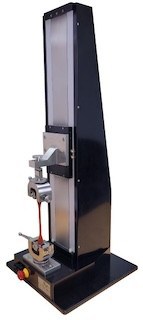
A key part of this work was the use of uniaxial tensile testing on regional supraspinatus tendon samples. Uniaxial tensile testing of supraspinatus tendon regions was performed using the CellScale UniVert to generate stress-strain data for finite element modeling. That mechanical data was then used to define material parameters for simulations designed to evaluate strain patterns in torn rotator cuff tissue under different loading conditions.

This study highlights how rotator cuff biomechanics research can connect direct mechanical testing with computational modeling to better assess tear progression risk and support more informed rehabilitation strategies.
Why Rotator Cuff Biomechanics Matters
Rotator cuff tears are a common source of shoulder pain and dysfunction. The supraspinatus tendon is especially important because of its role in shoulder stability and movement, but it is also vulnerable to injury and degeneration. Understanding rotator cuff biomechanics is challenging because tendon structure is region-dependent, mechanically complex, and difficult to study directly in vivo.
For this reason, researchers increasingly combine experimental testing with computational methods. In this study, mechanical characterization of tendon tissue was used to inform finite element analysis, allowing the team to investigate internal strains that cannot be measured easily during normal patient activity.
Mechanical Testing of Supraspinatus Tendon Regions
To build an accurate model, the researchers first characterized the mechanical behavior of different supraspinatus tendon regions. Six fresh-frozen intact human shoulders were prepared, and the supraspinatus tendons were divided into regional samples representing different anatomical locations.
These samples were then tested using uniaxial tensile testing on the UniVert. The goal was to generate stress-strain data for each region without causing permanent damage to the tissue. This step was essential because tendon properties are not uniform across the supraspinatus. Regional variation in structure and mechanics influences how loads are distributed and how tears may progress.
For studies in rotator cuff biomechanics, this kind of tensile testing of tendons is important because it provides direct experimental data on tissue response under controlled loading.
How UniVert Data Supported Finite Element Modeling
One of the most important aspects of this study is the clear link between mechanical testing and computational simulation.
The workflow was:
-
Uniaxial tensile testing was performed on supraspinatus tendon regions using the UniVert
-
Stress-strain data were collected from each region
-
Collagen orientation was evaluated histologically
-
These inputs were used to fit a constitutive soft tissue model
-
The resulting material parameters were applied in finite element modeling of rotator cuff tears
This connection is important because it shows how experimental mechanics can improve simulation quality. Rather than assuming generic material properties, the model was informed by measured tendon behavior. That makes the finite element analysis more relevant to actual tendon mechanics.
Finite Element Modeling of Rotator Cuff Tears
Using the measured material properties and collagen orientation data, the researchers simulated crescent-shaped tears in the posterior third of the supraspinatus tendon. The simulations focused on small- and medium-sized tears, which are clinically important because they are often managed conservatively before surgery is considered.
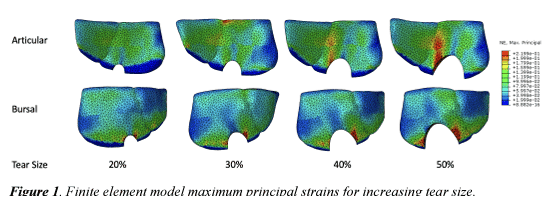
The purpose of the model was to evaluate internal strain patterns during daily activities and rehabilitation exercises. This is a valuable application of rotator cuff biomechanics research because it helps identify which activities may remain within a safer strain range and which may increase the risk of tear progression.
Key Findings on Rotator Cuff Tear Progression
The study found that tendon strain increased as tear size increased. However, many daily activities and certain rehabilitation exercises remained below strain levels associated with higher risk of progression.
Important findings included:
-
strain rose with increasing tear size
-
smaller tears showed differences between bursal-side and articular-side strain at the tear tips
-
medium-sized tears showed elevated strain risk during prone abduction at higher loading levels
-
external rotation produced lower strain levels than some other movements
-
routine daily activities such as typing, drinking, and brushing teeth remained below concerning strain ranges
These results are useful because they help translate rotator cuff biomechanics into clinically relevant insight. They suggest that not all loading is equally risky and that rehabilitation can potentially be tailored more effectively when tissue-level mechanics are understood.
Why Tensile Testing of Tendons Was Critical
This study depended on tensile testing of tendons because finite element models are only as useful as the material data used to build them. The supraspinatus tendon is structurally heterogeneous, and its mechanical response reflects both regional composition and collagen organization.
Without direct mechanical characterization, the model would have relied on generalized assumptions. By using the UniVert for uniaxial testing, the researchers were able to define region-specific behavior and improve the realism of their simulations.
For translational biomechanics research, this is an important point: mechanical testing is not separate from modeling. It is what makes patient-relevant modeling more credible.
Patient-Specific Modeling and Rehabilitation Strategy
A major implication of this work is the value of patient-specific or tissue-specific modeling in rehabilitation planning. If clinicians can better understand how tear size, tendon structure, and loading conditions influence internal strain, they may be able to reduce progression risk through more personalized exercise selection.
This is especially relevant because physical therapy is often successful for small- to medium-sized rotator cuff tears, but outcomes can worsen when tear characteristics and tissue loads are not adequately considered. Research in rotator cuff biomechanics helps support a more measured approach to rehabilitation by linking activity choice to tissue mechanics.
Why This Research Matters
This study is a strong example of how rotator cuff biomechanics research can bridge experimental mechanics and computational modeling. By combining uniaxial tensile testing of supraspinatus tendon regions with finite element simulation, the researchers generated a more detailed understanding of tear-tip strain and progression risk.
For CellScale readers, it also shows the research value of the UniVert in musculoskeletal soft tissue studies. Mechanical testing data from the UniVert directly supported constitutive modeling and simulation, making it part of a workflow that extends from bench testing to clinically relevant biomechanical analysis.
Conclusion
Understanding rotator cuff biomechanics requires more than imaging or clinical observation alone. Tendon tears develop and progress through complex internal strain patterns that depend on tissue structure, tear size, and applied loading.
In this study, uniaxial tensile testing on the CellScale UniVert provided the stress-strain data needed to inform finite element modeling of rotator cuff tears. That connection between mechanical testing and simulation helped clarify how different loading scenarios affect internal tendon strain and may ultimately support better rehabilitation planning for patients with rotator cuff injuries.
Read the full publication here.