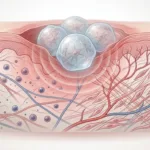
Conducting polymers are useful in bioelectronics because they can form a soft, electrically active interface between an electrode and biological tissue. Materials such as PEDOT:PSS, polypyrrole, and polyaniline have attracted so much interest for exactly that reason. They combine conductivity, biocompatibility, and favourable mechanical behaviour in ways that make them attractive for implanted and wearable devices.
The problem is that wet conducting polymers do not always stay attached very well once they are placed in a physiological environment. Swelling, hydration, and repeated mechanical or electrochemical loading can cause interfacial failure, which means the coating may debond even if the polymer itself still has useful electrical properties. That is one reason adhesion has been such a persistent issue in bioelectronics.
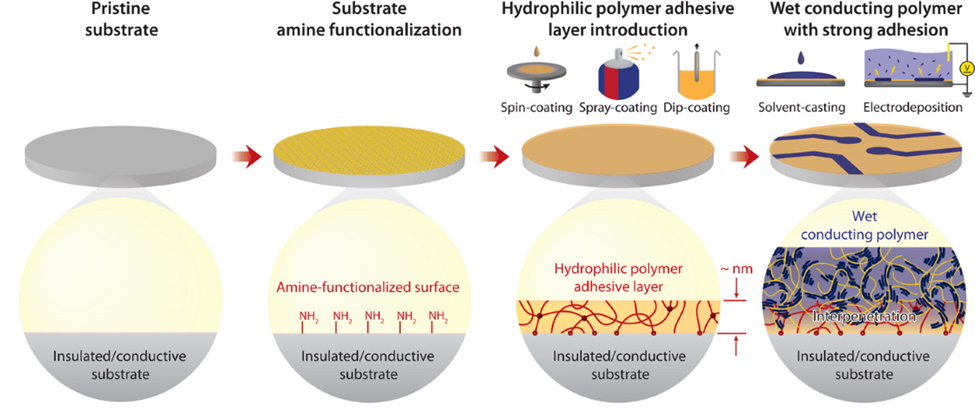
The study published here out of the Zhao Lab at MIT addressed that problem by introducing a very thin hydrophilic polymer adhesive layer that strongly bonded wet conducting polymers to a wide range of insulating and conductive substrates.
Why wet adhesion matters in bioelectronics
In a dry benchtop test, a conducting polymer coating may appear stable enough. In a wet physiological environment, the picture can change quickly. If adhesion is weak, the coating can delaminate, electrical performance can deteriorate, and the interface becomes less reliable over time. For implantable and wearable bioelectronics, that is a major limitation because the device only works as intended if both electrical and mechanical integrity are maintained.
That is why this paper is useful beyond its materials result. It is really about interfacial mechanical integrity in an application area where the interface often determines whether the device remains functional. For readers interested in related application areas, see our page on Wearable Bioelectronics.
How the adhesion strategy worked
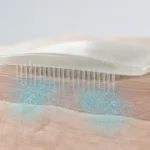
The method itself was relatively simple. The team first functionalized the substrate surface with primary amine groups. They then introduced a nanometre-thick hydrophilic polyurethane adhesive layer by spin coating, spray coating, or dip coating. After that, the conducting polymer was prepared on top by solvent casting or electrodeposition. The adhesive layer swelled and allowed precursor diffusion, which helped form an interpenetrating polymer network between the conducting polymer and the adhesive layer. That combination of substrate bonding and polymer interpenetration is what gave the interface its strength.
One of the most useful aspects of the method is that it was not limited to one polymer or one substrate. The paper reports strong adhesion for PEDOT:PSS, PPy, and PAni on glass, polyimide, PDMS, ITO-glass, and gold, which makes the method much more broadly useful than approaches tied to one specific formulation.
What the mechanical testing showed
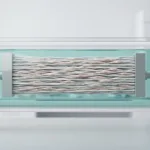
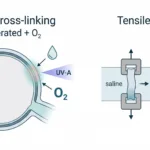
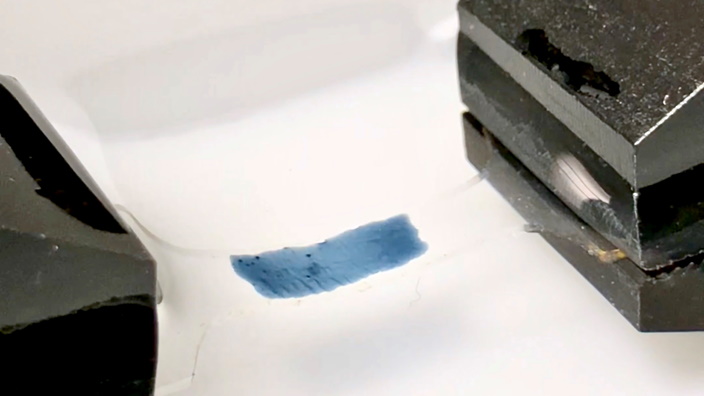
The study used lap-shear mechanical testing to quantify adhesion strength and tensile adhesion testing to check whether the adhesive layer altered the bulk mechanical behaviour of the wet conducting polymer.
The lap-shear results were strong. On amine-functionalized glass with the PU adhesive layer, wet PEDOT:PSS reached about 160 kPa shear strength, compared with almost no meaningful adhesion on pristine glass without the layer. The same general improvement was shown for PPy and PAni, and wet PEDOT:PSS also achieved shear strengths above 100 kPa on polyimide, PDMS, ITO-glass, and gold. The graphs below show this clearly, along with the shift from adhesive failure to cohesive failure once the interface became stronger than the bulk wet polymer.
For a related method overview, see our page on Shear Testing.
Why tensile testing still mattered
The adhesion layer needed to do more than hold the coating in place. It also needed to avoid changing the mechanical behaviour of the wet conducting polymer in a way that would defeat the point of using it. That is why the tensile testing was important.
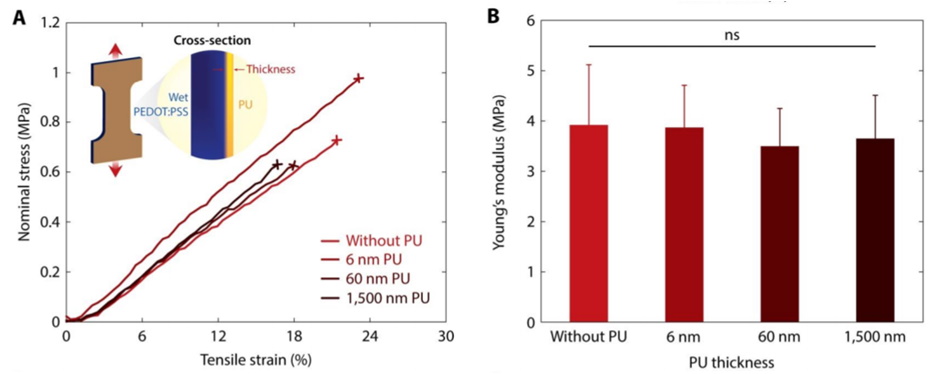
The paper reports tensile tests of solvent-cast wet PEDOT:PSS in PBS with and without PU adhesive layers of different thicknesses. The results showed no statistically significant difference in Young’s modulus or ultimate tensile strain across a wide range of adhesive thicknesses, which meant the adhesive layer could strengthen the interface without compromising the bulk mechanical properties of the polymer.
Those tensile tests were performed in a PBS bath using a CellScale UStretch (now upgraded to the UniVert) to avoid dehydration during testing.
Electrical performance was preserved with thin adhesive layers
A strong adhesive interface would not be very useful if it blocked electrical function. That is why the conductivity and impedance data matter so much in this paper.
The authors measured conductivity, sheet resistance, and impedance for wet PEDOT:PSS with different PU layer thicknesses. The key result was that very thin PU layers, especially in the nanometre range, preserved favourable electrical performance, while much thicker layers increased interfacial resistance and impedance. The data on page 5 show that 6 and 60 nm adhesive layers had little effect on conductivity or sheet resistance, whereas the 1500 nm layer substantially worsened the interface electrically. That made the thin adhesive layer essential not just mechanically, but electrically as well.
Strong adhesion held up in wet physiological conditions
The most convincing part of the paper is probably the stability work. The adhered conducting polymers were not only stronger in an initial test. They also stayed intact under conditions meant to challenge the interface.
The paper shows that solvent-cast PEDOT:PSS without the adhesive layer delaminated from ITO-glass after just 1 minute of ultrasonication in PBS. By contrast, PEDOT:PSS on amine-functionalized ITO-glass with the PU layer remained intact after 10 minutes of ultrasonication and showed negligible change in electrical behaviour. The same section also reports that PEDOT:PSS adhered on PDMS with the PU layer withstood 10,000 bending cycles in PBS without interfacial failure.
The electrochemical stability was also strong. PEDOT:PSS on Pt with the PU adhesive layer showed less than 6% decrease in charge storage capability after 10,000 cyclic voltammetry cycles, again without observable interfacial failure. That is a strong result for long-term bioelectronic relevance.
Why this matters for bioelectronic devices
This work is important because it connects materials design with device reliability. A conducting polymer coating is only useful in practice if it stays conductive, stays attached, and survives repeated loading in a wet environment. This method addressed all three at once.
The paper also went beyond flat coupons and demonstrated adhered electrodeposited PEDOT:PSS on representative bioelectronic devices, including microelectrode arrays and Pt microwire electrodes. The device results show that coatings with the adhesive layer remained intact after prolonged ultrasonication, while the unbonded versions showed obvious deterioration or damage. That makes the work especially relevant for implantable and flexible bioelectronics, not just for materials characterization.
For readers interested in adjacent material systems, see our page on Electroactive & Photothermal Polymers. If your work involves bonding performance more broadly, our Adhesives & Sealants Testing page is also relevant.
Where CellScale fit into the study
Tensile tests of wet PEDOT:PSS were performed in PBS using a CellScale mechanical tester. Those tests were used to determine whether the adhesive layer changed the bulk mechanical response of the conducting polymer under varying adhesive-layer thicknesses. The answer was essentially no for thin, useful adhesive layers, which is part of why the approach was so compelling.
If you want to see another adhesion-focused method example, read our post on lap-shear testing with the UniVert for oral drug delivery.
Full publication
The full MIT-based study is here: Strong adhesion of wet conducting polymers on diverse substrates.
Final takeaway
This paper is best understood as a study in wet conducting polymers and long-term interface reliability. The central result is not just that adhesion improved. It is that adhesion improved without sacrificing the electrical or mechanical properties that make these polymers useful in the first place. For bioelectronic devices in wet physiological conditions, that is a big difference.